
Inside the Production Process of a High-End Women's Apparel Supplier in China
Curious how a high-end women's apparel supplier China turns design ideas into premium finished garments? This article takes you inside the production process of Shenzhen Meiwuzhi Garment Co., Ltd., from pattern making and material sourcing to knitting, accessories, quality control, and bulk manufacturing, revealing how an integrated supply network supports consistent quality, fast response, and reliable apparel production for modern fashion businesses.
What does a high-end women's apparel supplier China really control?
For operators, the biggest concern is not just whether a factory can sew garments. The real question is whether the supplier can control each production link without losing speed, quality, or style accuracy.
A high-end women's apparel supplier China typically needs stronger coordination than a mass-market garment maker. Premium women’s fashion requires tighter fabric handling, cleaner silhouettes, better trims, stable sizing, and more disciplined quality checks.
Shenzhen Meiwuzhi Garment Co., Ltd. operates with its own factory in Changping Town, Dongguan, while also cooperating with more than ten factories across Dongguan, Zhongshan, and Suzhou in Guangdong, plus Suzhou in Jiangsu. This structure matters because it supports both specialization and flexibility.
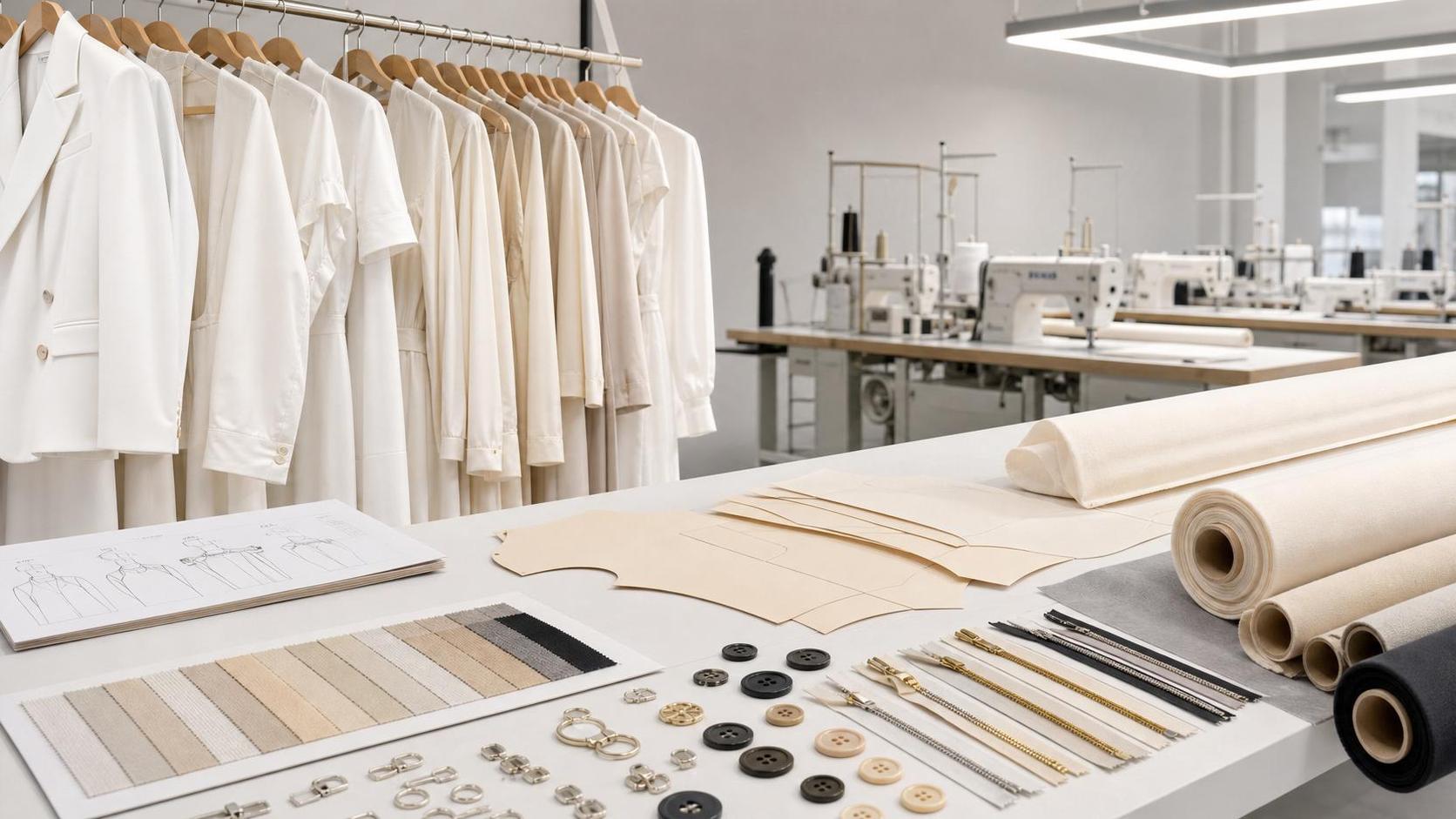
- Its own factory handles design, pattern making, accessory production, knitting processing, and bulk garment production.
- Its wider supply network helps absorb order fluctuations, style diversity, and seasonal production pressure.
- Its Shenzhen showroom supports style display and in-stock business for retailers and online wholesale buyers.
For a buyer or production operator, this means fewer handoff errors than in a fragmented sourcing model where design, sampling, knitting, trims, and sewing are scattered among unrelated vendors.
Why integration matters in premium women’s fashion
High-end women’s apparel is highly sensitive to fit, drape, trim consistency, and visual balance. A slight mismatch in rib color, zipper tone, emblem positioning, or fabric shrinkage can damage the final retail value.
That is why an integrated high-end women's apparel supplier China is often preferred by brands, wholesalers, and store operators who need repeatable standards, quick sample revisions, and better control over replenishment.
How the production process works from sketch to bulk delivery
To understand whether a supplier fits your business, it helps to break the production process into practical stages. Each stage affects lead time, cost, and product stability.
The table below shows how a high-end women's apparel supplier China like Meiwuzhi moves a women’s apparel style through production and where operators should focus their checks.
This process view is useful because operators often lose control not in sewing, but in earlier decisions such as pattern judgment, trim selection, and pre-bulk approval. Those early choices determine whether a style can scale smoothly.
Design and pattern making: where premium fit starts
Meiwuzhi’s own factory handles design and pattern making, which is a major advantage for premium women’s fashion. In high-end apparel, fit is not a final adjustment. It is the foundation of the style’s commercial value.
Pattern makers must translate a concept into actual proportions: shoulder angle, bust ease, waist line, sleeve volume, hem balance, and movement allowance. If this step is outsourced loosely, later revisions become slower and more expensive.
Material and accessory matching: details decide retail perception
A high-end women's apparel supplier China must manage more than the shell fabric. Premium perception depends on zippers, contrast trims, labels, rib, buttons, thread matching, and finishing consistency.
For example, a sporty premium style may rely on the visual sharpness of striped trim and the feel of a soft, skin-friendly fabric. If the trim is too hard, the fabric too thin, or the zipper tone too bright, the look becomes less refined.
A representative style direction can be seen in ZL5617 Miu 26SS, which combines tennis club aesthetics with daily outfits through a neat tailored cut, a clean white base, blue trim, zipper details, and an iconic emblem. This kind of product requires balanced execution, not just visual imitation.
What operators should inspect at each production step
Many sourcing problems happen because operators inspect too late. In premium women’s apparel, quality control should be distributed throughout the process, not saved for final inspection only.
- Before sampling, confirm bill of materials, target look, size range, and trim references.
- During sampling, check fit on body, seam cleanliness, fabric response after pressing, and visual harmony.
- Before bulk, lock approved color, approved trims, construction notes, and packaging requirements.
- During bulk, inspect early production output for recurring defects and tolerance drift.
- Before shipping, inspect measurement consistency, final appearance, labeling, and carton assortment.
Typical quality risks in high-end women’s apparel
Operators working with a high-end women's apparel supplier China should pay special attention to risks that are easy to miss in sample approval but highly visible in bulk goods.
- Fit inconsistency between sample and bulk due to fabric lot differences or cutting tolerance.
- Trim color mismatch, especially in striped rib, contrast piping, zipper tape, or emblem embroidery.
- Uneven pressing or puckering around zipper and seam intersections.
- Soft-touch fabrics losing shape if the pattern structure is not stable enough.
- Packaging confusion across sizes such as S, M, and L when replenishment is urgent.
The strength of an integrated supplier lies in catching these problems early. Pattern making, accessory production, knitting processing, and bulk manufacturing under coordinated management reduce the communication gap that often causes avoidable defects.
How Meiwuzhi’s supply network supports speed and consistency
A single factory can be efficient, but premium apparel businesses often need broader capacity. Seasonal launches, repeat orders, and multi-style collections create pressure that one site may not absorb alone.
Meiwuzhi combines its own production base with cooperative factories in key manufacturing areas. For operators, this matters because capacity planning becomes more resilient without fully giving up technical control.
The comparison below shows why this hybrid structure is practical for buyers searching for a high-end women's apparel supplier China.
For Meiwuzhi, the own-factory role is especially important because it anchors the critical development functions. That gives buyers a clearer center of accountability than a loose trader model with minimal technical ownership.
Commercial signals that matter to buyers
Over 12 years on Alibaba, sales exceeding 350 million yuan, more than 130 cooperative physical stores nationwide, and over 45,000 online cooperative WeChat business partners and online store clients all indicate sustained market activity. These figures do not replace product evaluation, but they show that the business has handled scale and repeat transactions over time.
The Shenzhen showroom in Nanshan also adds practical value. Operators can review current styles, assess workmanship directly, and speed up decision-making on in-stock or follow-up wholesale needs.
How to choose a high-end women's apparel supplier China for your operation
Choosing the right partner is rarely about the lowest quoted unit price. For operators, the better question is whether the supplier fits your product rhythm, margin target, and quality expectation.
Use the following evaluation points when comparing suppliers for premium women’s apparel production.
This framework helps separate price-led sourcing from value-led sourcing. In premium women’s fashion, poor control usually costs more later through markdowns, rework, delays, or customer dissatisfaction.
When an in-stock plus production model is useful
Some operators need both current ready styles and custom production support. That is common in retail chains, online wholesalers, social sellers, and boutique stores testing trend response.
In that context, the showroom model can reduce decision friction. Buyers can evaluate immediate saleability while still discussing longer-term custom or repeat production. A style such as ZL5617 Miu 26SS works well as an example because its sporty retro look has both styling identity and daily wear relevance.
Common questions operators ask before placing an order
How do I judge whether a sample is truly ready for bulk production?
Do not approve based on appearance alone. Check fit, stitch quality, pressing response, trim consistency, measurement tolerance, and packaging logic. Also ask whether the approved sample uses the same bulk-intended fabric and trims. If not, bulk risk remains high.
What is the biggest mistake when choosing a high-end women's apparel supplier China?
The most common mistake is focusing only on unit price while ignoring development control. A lower quote may hide slower revisions, weaker trim management, unstable output, or poor consistency across sizes. For premium women’s apparel, those problems directly affect sell-through.
Which styles benefit most from integrated production capability?
Styles with contrast trims, shaped tailoring, knitted components, visible zipper details, decorative emblems, or soft-touch fabrics benefit the most. These products need multiple departments to work closely, otherwise the final look may drift from the design concept.
How should I prepare for a supplier discussion?
Bring a tech pack if possible, but at minimum prepare reference photos, target size range, quantity estimate, fabric expectations, required trims, planned selling season, and desired delivery window. The clearer your input, the more accurately the supplier can assess feasibility and timing.
Why many buyers work with suppliers that combine production and market feedback
Production ability matters, but market feedback also matters. A supplier serving physical stores, online wholesalers, and social commerce channels can often respond more sharply to style movement, replenishment rhythm, and visual merchandising expectations.
Meiwuzhi’s long-term commercial presence, physical store cooperation across many cities, and large online partner base suggest exposure to real selling conditions. For operators, that can be helpful when balancing style appeal with manufacturability.
Why choose us for premium women’s apparel production
If you are evaluating a high-end women's apparel supplier China, the strongest reason to speak with Meiwuzhi is not a generic claim. It is the combination of in-house development capability, coordinated factory resources, showroom support, and long-term wholesale operating experience.
- You can discuss pattern feasibility and fit direction before committing to bulk production.
- You can confirm fabric, trims, accessory matching, and construction details with clearer production ownership.
- You can ask about delivery planning based on order volume, style complexity, and seasonal schedule.
- You can review in-stock or showroom styles while planning custom or repeat orders.
- You can request support on size confirmation, sample development, quotation communication, and bulk process coordination.
For operators managing premium women’s fashion, the practical next step is to prepare your target style, quantity, timeline, and quality expectations, then discuss sample support, product selection, delivery cycle, customization options, and pricing logic in one structured conversation. That is the fastest way to judge whether the supplier can support your business reliably.
Previous:No more content
Next:No more content


Please give us a message
Contact Us