
Lead Times at a High-End Women's Apparel Supplier in China Explained
For project managers sourcing premium fashion, understanding lead times is critical to keeping launches on schedule and inventory risks low. This guide explains what to expect when working with a high-end women's apparel supplier China buyers can rely on, from design and sampling to bulk production and delivery. Learn how factory capacity, craftsmanship, and supply coordination affect timelines and how to plan with greater confidence.
What Buyers Really Need to Know About Lead Times
When sourcing from a high-end women's apparel supplier China offers, the central question is rarely just “how long will production take.” Project managers usually need to know whether a supplier can deliver premium garments on time without compromising quality.
The short answer is that lead times for high-end women's fashion are shaped by product complexity, sampling rounds, fabric readiness, trim development, and production coordination across multiple workshops. Premium suppliers often need more time than mass-market vendors, but the process is usually more predictable when managed correctly.
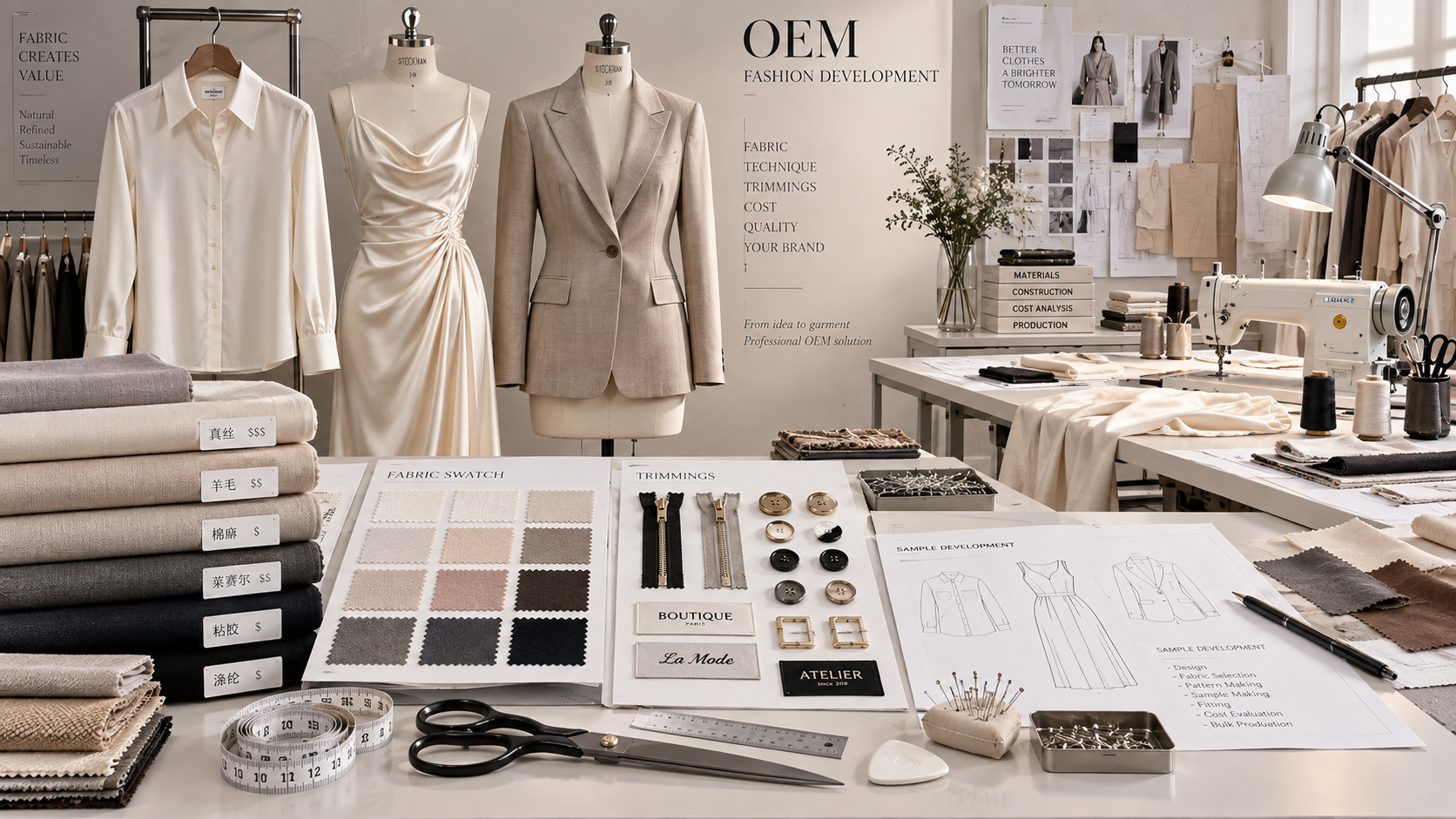
For planning purposes, buyers should expect the full cycle to include design confirmation, pattern development, sample approval, material sourcing, pre-production checks, bulk manufacturing, finishing, and shipment preparation. The more refined the product, the less room there is for rushed decisions.
Why Premium Women's Apparel Takes Longer Than Standard Garments
High-end women's fashion involves tighter quality standards, more detailed construction, and stronger expectations around fit, silhouette, and finishing. These factors make production timelines different from basic commodity apparel.
A premium dress, tailored set, or structured seasonal item may require multiple sample revisions before approval. Details such as neckline balance, shoulder proportion, waistband structure, trim placement, and fabric behavior under wear all affect whether a style is ready for bulk production.
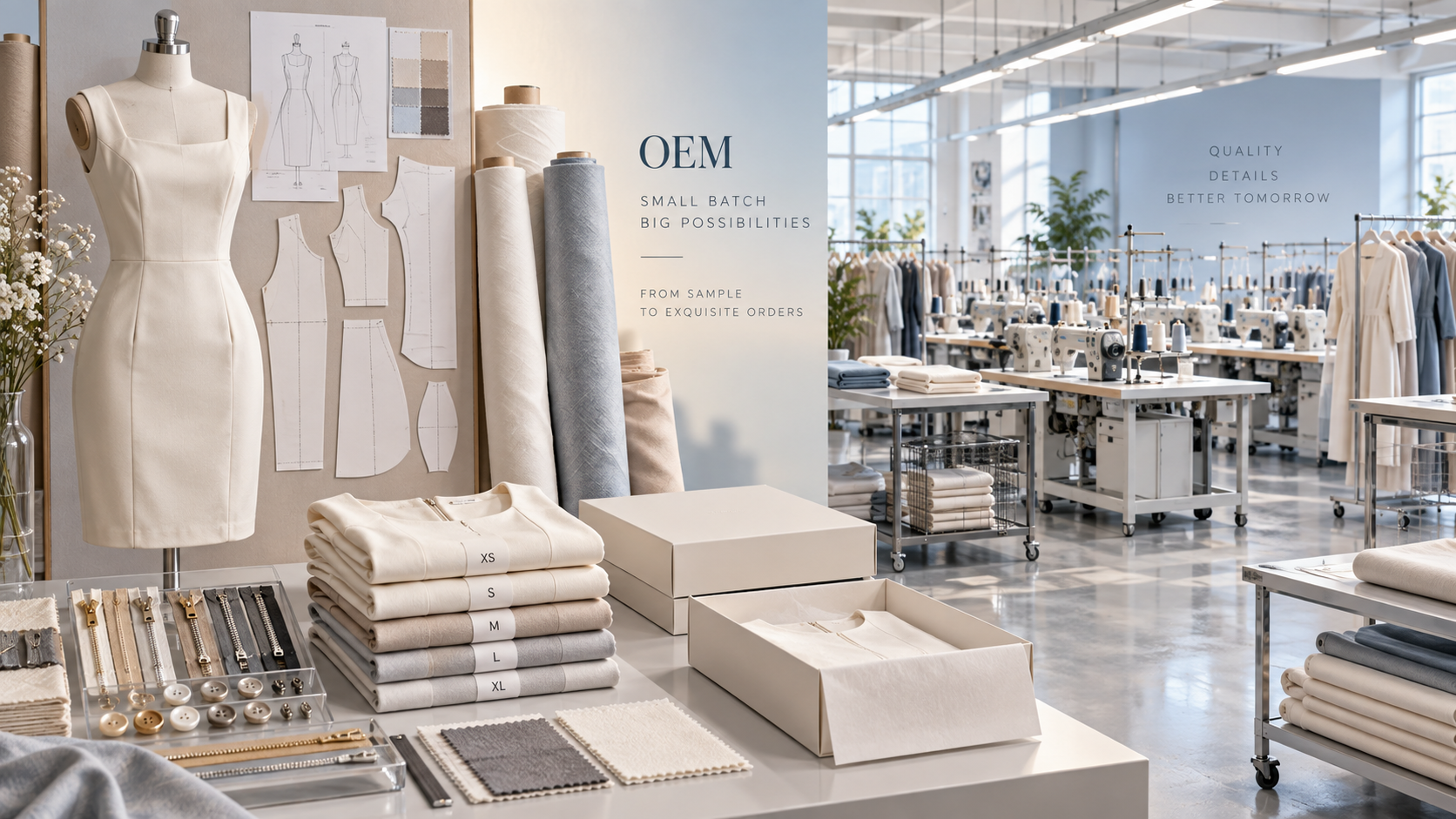
For example, a vintage workwear-style design made from stiff cotton fabric with a sleek tailored silhouette demands more pattern precision than a loose casual item. Elements like wide shoulder straps, a square neckline, and a matching wide waistbelt must all align correctly to achieve the intended fit and structure.
This is why professional buyers should not judge a supplier only by the shortest quoted schedule. A realistic lead time is often a sign that the factory understands the quality level required and has built enough time for control points.
Typical Lead Time Stages at a High-End Women's Apparel Supplier in China
For project planning, it helps to break the timeline into clear stages. Most premium suppliers in China follow a process that can be estimated and managed if expectations are aligned early.
The first stage is design and technical review. If buyers provide reference samples, tech packs, measurement charts, or fabric requirements, the supplier can confirm feasibility faster. This stage may take a few days to over a week depending on clarity and style complexity.
The second stage is pattern making and sample development. For premium women's garments, this can take one to three weeks. If the item includes custom trims, structured shaping, or signature detailing, the timeline may extend further.
The third stage is sample revision and approval. This is where many projects either stay controlled or begin slipping. If decision-makers take too long to approve revisions or keep changing details late, production schedules become unstable.
The fourth stage is bulk material preparation. Fabric booking, dyeing, accessory production, knitting support, washing tests, and labeling all need coordination. For higher-end orders, suppliers often wait until the approved sample is locked before committing full material allocation.
The fifth stage is bulk production. Depending on order size, style count, sewing difficulty, and finishing requirements, this stage may take several weeks. Inspection, pressing, packaging, and export preparation follow before dispatch.
What Affects Lead Time More Than Buyers Expect
Project managers often assume factory sewing capacity is the main variable. In reality, upstream and pre-production decisions usually have a bigger effect on schedule reliability than the sewing line itself.
Fabric availability is one major factor. If a style depends on a specific premium fabric, color, weight, or hand feel, sourcing time can add significant days. Even when the factory is ready, production cannot begin until materials meet quality and consistency requirements.
Accessories and trims also matter. Customized buttons, belts, labels, embossing, and branded components often introduce hidden delays. A small trim issue can hold up a full production run if the item cannot be packed or quality-approved without it.
Fit approval is another major timeline driver. Women's tailored products require close control of body proportion and line balance. Repeated revisions on neckline depth, waist shaping, or chest placement can be necessary, especially for premium silhouettes intended to flatter precisely.
Communication speed matters just as much. When feedback is delayed across merchandising, product, compliance, and management teams, even a capable supplier loses momentum. Fast, consolidated approvals reduce friction throughout the process.
How Supplier Structure Impacts Delivery Reliability
Not every apparel manufacturer has the same operational model. For project managers, understanding a supplier’s structure is essential because lead time reliability depends on more than headline factory capacity.
Shenzhen Meiwuzhi Garment Co., Ltd. presents an example of a supplier whose capabilities are supported by both owned production resources and coordinated partner factories. Its own factory in Changping Town, Dongguan, handles design, pattern making, accessory production, knitting processing, and bulk garment manufacturing.
In addition, the company works with more than ten factories across Dongguan, Zhongshan, and Suzhou in Guangdong Province, as well as Suzhou in Jiangsu Province. That network matters because it provides flexibility when a project includes different process requirements, seasonal peaks, or varied order structures.
For buyers, this kind of supply model can shorten bottlenecks if managed well. Internal control over pattern making and sample development improves responsiveness, while distributed production support can help maintain throughput during larger or multi-style orders.
At the same time, a broader network only adds value when coordination is disciplined. Project managers should ask who controls scheduling, how quality standards are unified, and whether critical production stages remain under direct supervision.
What a Realistic Lead Time Range Looks Like
Although every project differs, buyers can use broad planning ranges as a starting point. For premium women's apparel, a repeat style with confirmed fabric and approved fit usually moves faster than a new development order.
For repeat orders, lead times may be relatively manageable if materials are available and line allocation is confirmed early. For new designs, especially those requiring custom construction or multiple revisions, buyers should plan for a substantially longer cycle.
In many premium sourcing scenarios, the most reliable schedule assumptions come from stage-by-stage commitment rather than one total promise. A supplier that explains timing for sampling, sourcing, bulk cutting, sewing, finishing, and shipment is often more trustworthy than one offering a vague overall number.
This is particularly important for launch-driven calendars. If your team is managing a seasonal launch, showroom schedule, retail drop, or wholesale delivery window, the date that matters is not factory start date but approved ex-factory readiness.
How to Evaluate Whether a Supplier’s Lead Time Quote Is Credible
Project managers should test a lead time quote the same way they test a budget: by checking what assumptions sit underneath it. A short promise without process detail often becomes a hidden risk later.
First, ask whether the quote includes sampling and revisions or only bulk production. Some suppliers state an attractive timeline that starts after approvals are complete, which can mislead buyers comparing options.
Second, confirm whether fabrics and trims are in stock, made to order, or still under sourcing review. Material status changes the production calendar more than most first quotations reveal.
Third, identify who owns critical stages such as pattern development, cutting, quality inspection, and finishing. The more fragmented those steps are, the more important project coordination becomes.
Fourth, ask how the supplier handles parallel orders during peak seasons. A supplier with stable systems, line planning, and long-term factory relationships is better positioned to protect timelines when demand rises.
Why Sample Quality Is a Lead Time Signal
Sample quality tells buyers more than aesthetic competence. It also indicates whether the supplier has the technical discipline to protect production schedules later.
If the first sample arrives with accurate construction, clean finishing, balanced proportions, and thoughtful material handling, it usually means the pattern room and development team are functioning well. That reduces the risk of repeated correction loops.
For instance, a structured seasonal style such as ZL5397 Miu* 26Ss would require the supplier to control shape, proportion, and visual detailing carefully. A sleek tailored look depends not just on sewing but on how the pattern, cotton stiffness, neckline shape, and waist definition work together.
When a supplier can execute these details consistently in sampling, buyers gain a more reliable basis for trusting the projected bulk timeline. In premium apparel, technical confidence at sample stage often predicts delivery confidence at production stage.
Planning Tactics That Help Project Managers Avoid Delays
Good suppliers matter, but buyer-side planning also determines whether schedules hold. Many lead time problems start with incomplete inputs or slow approvals rather than factory failure alone.
One effective tactic is to freeze product requirements earlier. Confirm measurements, construction comments, artwork, labels, packaging, and performance expectations before materials are booked. Late changes are expensive in both time and coordination effort.
Another tactic is to align internal approvers in advance. If merchandising, design, sourcing, and management review samples separately over several days, the factory loses valuable momentum. Consolidated approvals shorten cycle time.
It also helps to build milestone tracking rather than waiting for final delivery updates. Ask for dates tied to sample completion, fabric readiness, cutting start, sewing progress, finishing, inspection, and packing. That allows intervention before a delay becomes unrecoverable.
Finally, keep contingency in the schedule for premium orders. The more complex the garment and the higher the finish standard, the more sensible it is to protect launch dates with buffer rather than operating on the factory’s most optimistic estimate.
What Business Scale Can Tell You About Operational Maturity
Operational history does not guarantee perfect execution, but it often signals how well a supplier manages demand volatility, client coordination, and order follow-through.
Meiwuzhi’s background includes 12 years of operation on Alibaba platform channels, cumulative sales exceeding 350 million yuan, more than 130 cooperating physical stores nationwide, and over 45,000 online cooperative WeChat business partners and online store clients.
For project managers, that scale suggests exposure to diverse order rhythms, replenishment cycles, and style turnover demands. A supplier serving both physical retail and online wholesale channels usually develops stronger habits around production planning and inventory movement.
The presence of the Tchu showroom in Nanshan District, Shenzhen, also indicates an active product presentation and style update workflow. For buyers, that may support faster selection, clearer communication, and smoother commercialization of trend-driven women's apparel programs.
How to Balance Speed, Quality, and Risk
Every sourcing decision involves trade-offs. Faster delivery can reduce launch risk, but if speed comes from skipping fit validation or compressing quality controls, the downstream cost may be much higher.
For high-end women's fashion, the best sourcing outcomes usually come from disciplined sequencing rather than rushed execution. A supplier should move quickly where speed is safe, such as early feasibility review and material planning, while protecting time for quality-critical stages.
Buyers should also think in terms of total project risk. A late but high-quality delivery may still be preferable to an on-time shipment that creates returns, brand damage, or unsellable inventory because the garment failed to meet premium expectations.
The goal is not simply to find the fastest high-end women's apparel supplier China can offer. The real goal is to find a partner whose timeline is believable, managed, and aligned with the business value of the product.
Final Takeaway for Project Managers
Lead times at a premium women's apparel supplier are driven by more than production speed. They reflect the full chain of design readiness, sample control, material sourcing, technical execution, and scheduling discipline.
When evaluating a high-end women's apparel supplier China buyers can trust, project managers should focus on process transparency, sample quality, material coordination, and delivery realism. These factors matter more than the shortest quoted number.
A supplier with in-house development capability, coordinated factory resources, and proven channel experience can offer stronger timeline confidence, especially for structured, fashion-sensitive, or quality-led programs. Better planning on the buyer side strengthens those advantages further.
In practical terms, reliable lead times come from shared discipline. When both buyer and supplier manage approvals, materials, and milestones carefully, premium fashion projects move with fewer surprises and much greater commercial confidence.
Previous:No more content
Next:No more content

Do Women’s Clothing OEM Factories Accept Small Boutique Orders?
Do women's clothing OEM factories handle small boutique orders? Learn how MOQ, fabrics, sampling, pricing, and quality control shape a reliable boutique production launch.
How Much Does Women’s Clothing OEM Typically Cost Per Unit?
How much does women's clothing OEM typically cost per unit? Explore practical price ranges, key cost drivers, MOQ impact, and smart sourcing tips to protect quality and profit margins.
Should Buyers Choose Women’s Clothing OEM or Ready Stock?
Is it better to use a women's clothing OEM or buy ready stock? Compare cost, speed, control, and risk to choose the right sourcing strategy for your fashion brand.

{item.title}
{item.description}
Please give us a message
Contact Us