
What Happens If a High-End Women's Apparel Shipment Arrives Defective?
When a high-end women's apparel shipment arrives defective, the first priority is to contain the damage, document the issue clearly, and activate a replacement or compensation process with the manufacturer. In most cases, the root cause falls into one of three categories: fabric problems, workmanship failures, or shipping-related damage. For retailers, wholesalers, and brand buyers, the real question is not only what went wrong, but how quickly the supplier can respond without disrupting sales, customer trust, and cash flow.
This is also where material knowledge becomes practical. Understanding what fabrics are commonly used in high-end women's apparel manufacturing helps buyers judge whether defects are linked to fabric instability, poor finishing, incorrect handling, or inconsistent production standards. In premium apparel, the supplier's quality control system matters just as much as design and price.
What should you do first when a luxury women's apparel shipment arrives defective?
The first 24 hours are critical. Before goods are redistributed, steamed, relabeled, or placed into inventory, the buyer should isolate the affected cartons and perform a structured inspection. This prevents mixed stock, preserves evidence, and makes supplier communication faster and more precise.
Start by checking whether the defect is isolated or batch-wide. Count affected units, record SKUs, colorways, sizes, carton numbers, and visible issue types. Take timestamped photos and short videos that show both close-up defects and full-garment context. This level of documentation reduces disputes and accelerates claim handling.
At the same time, compare the shipment against approved pre-production samples, sealed samples, measurement specs, and packaging standards. A defect is easier to resolve when both sides can trace it against an agreed benchmark rather than relying on subjective judgment after delivery.
Which defects matter most in high-end women's apparel?
Not every defect has the same business impact. In premium women's fashion, some issues can be repaired or discounted, while others make the product unsellable. Buyers should separate cosmetic flaws from structural quality failures as early as possible.
High-risk defects include fabric pulls, dye inconsistency, seam slippage, broken zippers, misaligned prints, needle damage, puckering, incorrect sizing, oil marks, and shape distortion. On premium garments, even small issues can trigger returns because customers expect consistency in fit, finish, and fabric handfeel.
Packaging and transit-related defects also matter. Crushed embellishments, moisture exposure, mold odor, hanger pressure marks, and wrinkling from poor folding can affect presentation and retail readiness. For luxury-positioned products, presentation quality is part of the product value, not an afterthought.
Can fabric choice explain why defects happen?
Yes, very often. Buyers searching what fabrics are commonly used in high-end women's apparel manufacturing are usually trying to understand quality expectations, durability, drape, and defect risk. Fabric behavior has a direct effect on how likely a garment is to fail during production, transport, or in-store handling.
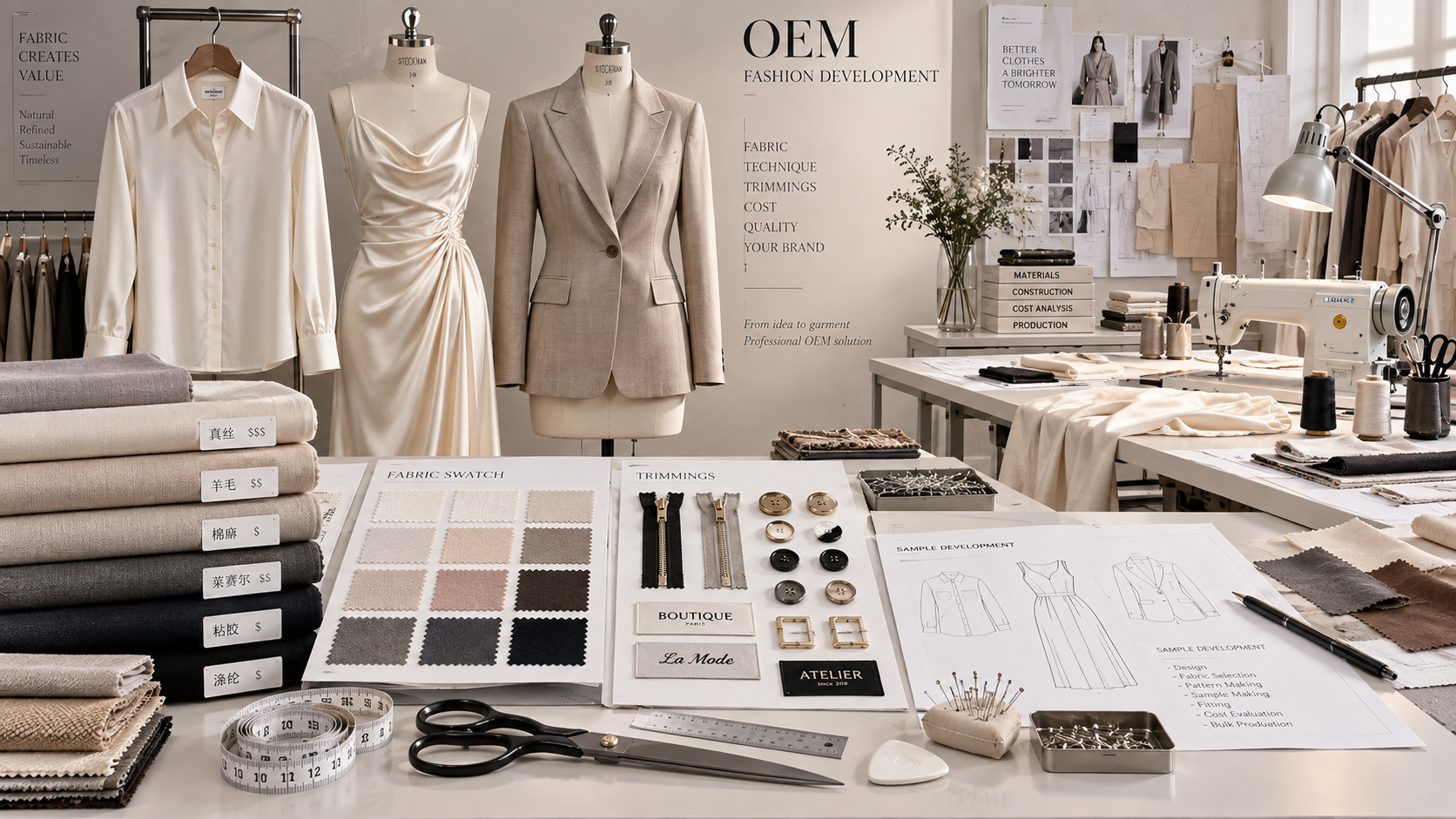
Common fabrics in high-end women's apparel manufacturing include silk, wool, cashmere blends, cotton poplin, fine linen, viscose, rayon blends, cupro, acetate, premium polyester blends, tweed, jacquard, chiffon, satin, ponte, and specialty knits. Each fabric has different performance requirements during cutting, sewing, pressing, washing, and packing.
Silk and satin, for example, are beautiful but vulnerable to snags, pressure marks, and water spotting. Linen can crease heavily and distort if finishing is inconsistent. Wool blends may show seam impressions or shrinkage issues if processing temperatures are poorly controlled. Knits can twist, stretch, or recover unevenly when tension settings are unstable.
That means a defect is not always the result of careless sewing. Sometimes the real cause is fabric instability, unsuitable interfacing, weak dye fixation, poor shrinkage control, or failure to match construction methods to the material. A capable manufacturer should understand these relationships before bulk production begins.
How can you tell whether the problem came from fabric, workmanship, or transit?
This distinction matters because it determines responsibility and the right remedy. If the issue is fabric-related, replacement may require new material sourcing or re-cutting. If it is workmanship-related, the supplier may be able to repair or remake quickly. If transit caused the damage, packaging and logistics become the focus.
Fabric-related defects usually appear as color migration, shade variation, unexpected shrinkage, pilling, weak recovery, holes from fabric flaws, skewing, or inconsistent texture across the same style. These problems often affect multiple pieces within the same lot and may appear even when sewing quality looks acceptable.
Workmanship defects tend to show up as uneven stitching, open seams, poor thread tension, inaccurate measurements, twisted side seams, incorrect labels, defective trims, misapplied lining, or badly attached embellishments. These are often traceable to line control, operator skill, or inadequate in-line inspection.
Transit damage usually presents differently. Carton crushing, moisture stains, mildew smell, deformed shoulder lines, broken accessories, and packaging abrasion are typical signs. If inner packing is intact but the garment is damaged, the issue may still trace back to packing method rather than shipping alone.
What should a reliable apparel manufacturer do after receiving a defect claim?
A serious supplier should respond with speed, structure, and accountability. That means confirming receipt of the claim, reviewing evidence, identifying whether the issue is partial or systemic, and offering a practical corrective plan rather than delaying the discussion.
The most useful response includes four things: a defect classification, root-cause analysis, corrective action timeline, and commercial solution. The commercial solution may involve replacement goods, repair support, credit notes, partial refund, or negotiated compensation depending on urgency and sell-through impact.
For premium buyers, communication quality is also a signal of operational maturity. If a supplier cannot quickly trace production lots, fabric batches, inspection records, and finishing history, future orders carry higher risk. Defect recovery is not just about this shipment; it reveals whether the factory can protect your business long term.
How do strong factories reduce the chance of defective premium apparel shipments?
Prevention starts long before bulk sewing. In high-end women's apparel manufacturing, quality depends on design translation, fabric testing, pattern precision, trim compatibility, process control, and final inspection discipline. Weakness in any one of these areas can show up as a defect after delivery.
Strong factories usually manage quality through pre-production sampling, fabric inspection, shrinkage and colorfastness testing, fit approval, pilot runs, in-line QC, final AQL inspection, and packaging verification. They also maintain clearer coordination between design, pattern making, accessory sourcing, knitting, and bulk production.
This integrated approach is especially important for premium women's fashion because materials are often delicate, silhouettes are more refined, and customer tolerance for inconsistency is low. A supplier with in-house control over multiple stages can often detect risk earlier and correct it before goods leave the factory.
For example, a manufacturer involved in design, pattern making, accessory production, knitting processing, and bulk garment production can often solve technical issues faster than a fragmented supply chain. When several partner factories are also coordinated under a stable production network, replacement and replenishment can move more efficiently.
Why does supply chain depth matter when defects affect a live selling season?
In premium apparel, timing is often as important as quality. If defective goods arrive during an active season, delayed replacement can mean missed launch windows, lost retail floor space, markdown pressure, and damage to customer confidence. A supplier's capacity to react quickly becomes a commercial advantage.
Factories with broader production coordination can usually shift workloads, remake urgent units, or prioritize replenishment more effectively. This matters for wholesalers, boutique retailers, and multi-channel sellers who need continuity across physical stores, private traffic channels, and online platforms.
Shenzhen Meiwuzhi Garment Co., Ltd. operates with its own factory in Changping Town, Dongguan, while also cooperating with more than ten factories across Dongguan, Zhongshan, and Suzhou. That kind of network can support design execution, production flexibility, and faster issue recovery when premium apparel orders face quality pressure.
Its parallel development of showroom and online distribution channels also reflects experience in balancing product presentation with scalable supply. For buyers, this kind of operating structure is relevant because defect resolution depends not only on sewing capacity, but on coordination across sampling, materials, production, and distribution.
How should buyers evaluate a supplier before placing a high-end women's apparel order?
The best time to manage defect risk is before production starts. Buyers should ask how the supplier handles fabric inspection, shrinkage testing, color approval, fit confirmation, in-line QC, and final shipment audits. A polished catalog alone does not prove process reliability.
Request clear answers on acceptable quality standards, defect claim procedures, lead times for remake orders, and documentation methods. It also helps to ask what fabrics are commonly used in high-end women's apparel manufacturing within that supplier's real production experience, not just in theory.
A qualified supplier should be able to explain which materials they handle confidently, what risks each fabric presents, how they stabilize quality, and where they set tolerance limits. That conversation often reveals more than a quotation sheet because it shows whether the factory understands premium product expectations in practice.
Buyers should also review sample consistency, finishing detail, seam cleanliness, pressing quality, trim durability, and packaging standards. If the supplier can deliver strong sample discipline and transparent communication early, bulk production is usually easier to control.
What is the long-term business lesson from a defective shipment?
A defective shipment is a quality problem, but it is also a supplier evaluation moment. It shows whether the manufacturer can protect margin, preserve selling timelines, and respond like a true partner when the order does not go as planned.
For high-end women's apparel, the right manufacturer is not simply the one offering attractive styling or competitive cost. It is the one that understands fabric behavior, executes refined workmanship, coordinates production reliably, and resolves problems without creating new commercial damage.
That is why knowledge of what fabrics are commonly used in high-end women's apparel manufacturing matters beyond design decisions. It helps buyers diagnose problems faster, ask better technical questions, and choose suppliers with the expertise to produce premium garments consistently.
When defects appear, the fastest route forward is disciplined inspection, evidence-based communication, and partnership with a manufacturer that has both quality systems and supply chain flexibility. In premium fashion, that combination is what protects reputation, inventory value, and customer trust.
Previous:No more content
Next:No more content

Do Women’s Clothing OEM Factories Accept Small Boutique Orders?
Do women's clothing OEM factories handle small boutique orders? Learn how MOQ, fabrics, sampling, pricing, and quality control shape a reliable boutique production launch.
How Much Does Women’s Clothing OEM Typically Cost Per Unit?
How much does women's clothing OEM typically cost per unit? Explore practical price ranges, key cost drivers, MOQ impact, and smart sourcing tips to protect quality and profit margins.
Should Buyers Choose Women’s Clothing OEM or Ready Stock?
Is it better to use a women's clothing OEM or buy ready stock? Compare cost, speed, control, and risk to choose the right sourcing strategy for your fashion brand.

{item.title}
{item.description}
Please give us a message
Contact Us