
What Is the Average Lead Time for High-End Women's Apparel Bulk Production?
What is the average lead time for high-end women's apparel bulk production? For premium fashion brands, the answer depends on design complexity, fabric sourcing, sampling, and factory coordination. With years of experience in high-end women’s wear manufacturing, Meiwuzhi helps clients balance quality, speed, and consistency. In this article, we break down the typical production timeline and the key factors that affect delivery.
What does lead time really include in high-end women’s apparel production?
When buyers ask, “What is the average lead time for high-end women's apparel bulk production,” they often mean more than sewing time. In premium womenswear, lead time includes development, sourcing, approvals, production planning, cutting, sewing, finishing, quality inspection, and shipment preparation.
For basic reorder styles using ready materials, the timeline can be much shorter. For new seasonal collections with custom trims, special dyeing, embroidery, or fitted tailoring, the timeline expands because each stage needs tighter review and more coordination.
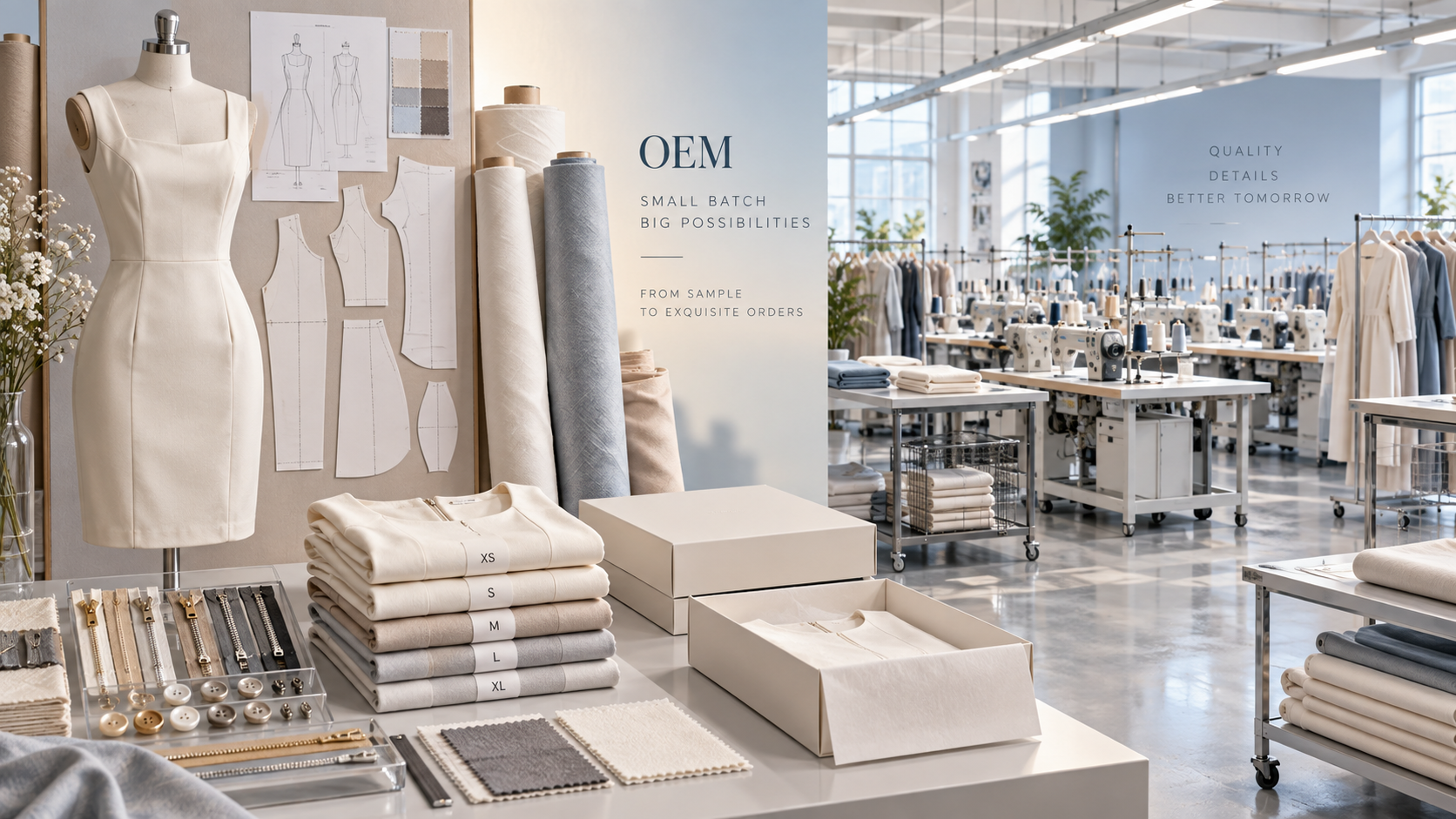
Meiwuzhi supports this process through its own factory capabilities in design, pattern making, accessory development, knitting processing, and bulk garment production, while also coordinating with partner factories across Dongguan, Zhongshan, Suzhou in Guangdong, and Suzhou in Jiangsu. This structure helps match the right production path to the order type.
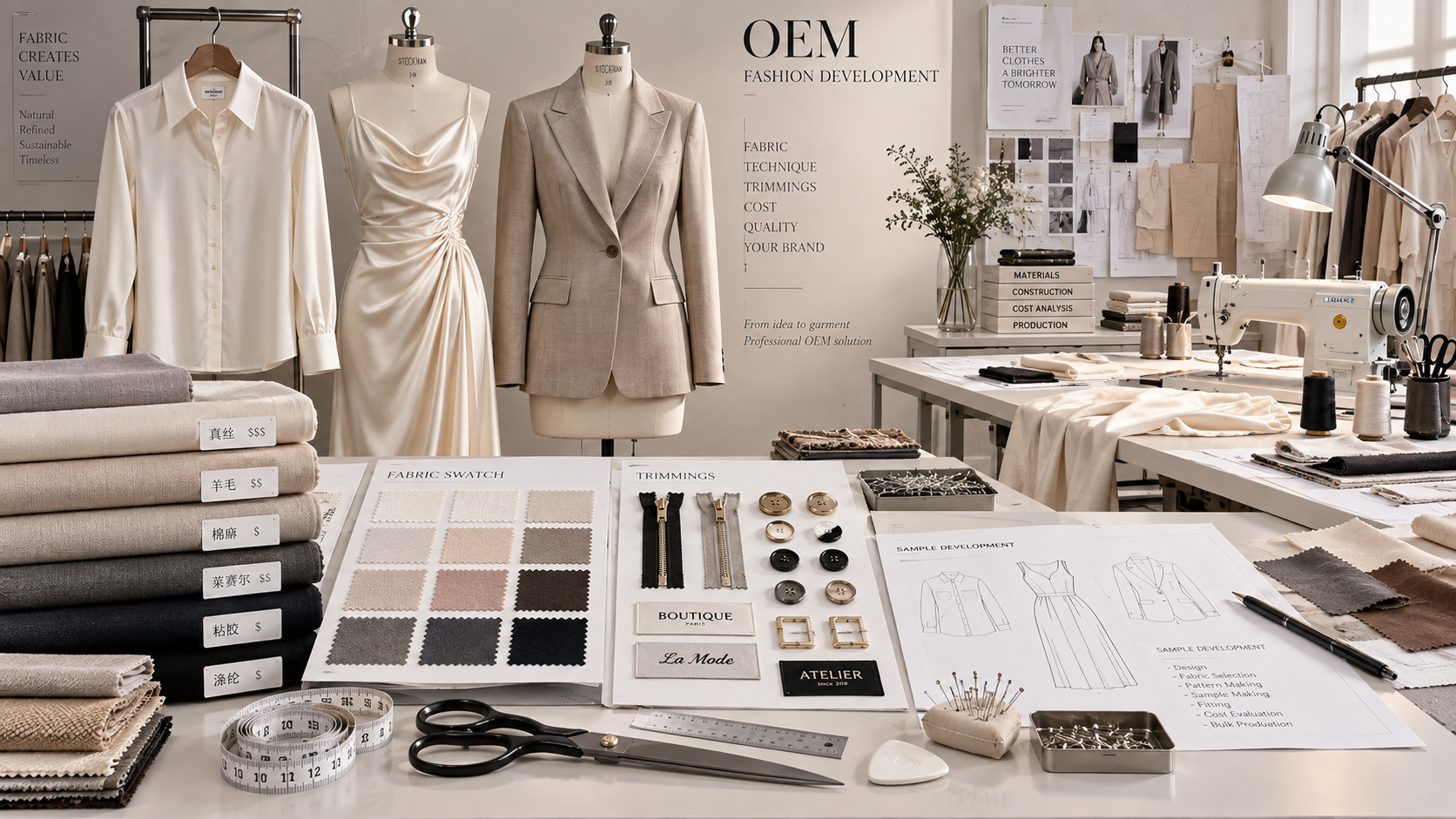
- Development lead time covers tech pack review, pattern adjustments, fit comments, and sample confirmation.
- Material lead time covers fabric booking, dyeing, printing, trim procurement, and incoming inspection.
- Production lead time covers line allocation, pre-production sample approval, cutting, sewing, finishing, and final inspection.
Why premium garments usually take longer than standard fashion orders
High-end women’s apparel has higher tolerance requirements. Buyers care about drape, silhouette, stitch consistency, lining behavior, trim placement, and luxury hand feel. A small issue in fit or fabric performance can delay approval because premium positioning leaves less room for compromise.
That is why an experienced manufacturer does not simply chase speed. The better approach is to control each approval point early, reduce rework, and keep the bulk schedule realistic from the beginning.
What is the average lead time for high-end women's apparel bulk production by order type?
The answer varies by style complexity and sourcing method. The table below shows a practical reference for buyers evaluating what is the average lead time for high-end women's apparel bulk production under different order conditions.
For many premium brands, 45 to 75 days is a reasonable benchmark after sample approval for a new style with stable sourcing. However, if the order involves imported-like fabrics, delicate knit structures, beading, pleating, or multiple fit revisions, the timeline can move closer to 90 days or beyond.
How MOQ and style count change the calendar
A larger quantity does not always mean a much longer lead time. In apparel, the bigger challenge is often too many styles in one order. Ten styles of 200 pieces each may require more development coordination than two styles of 1,000 pieces each.
This is where Meiwuzhi’s multi-factory coordination becomes useful. Different categories and processes can be assigned to suitable production resources, reducing bottlenecks while preserving quality control for high-end women’s wear.
Which stages usually delay premium women’s apparel orders?
If you want a realistic answer to what is the average lead time for high-end women's apparel bulk production, you need to identify the stages most likely to create delay. In premium apparel, the biggest risks usually happen before bulk cutting starts.
The following table shows common stages, expected timing, and what can go wrong if they are rushed or poorly managed.
The key insight is simple: most late deliveries begin with weak development control. If pattern comments, fabric approval, and trim details are not locked early, the final shipment date becomes unstable no matter how fast the sewing floor works.
High-risk details that buyers often overlook
- Special fabrics such as chiffon, silk blends, tweed, bouclé, and fine knits often need extra handling tests before bulk cutting.
- Decorative trims may have different replenishment times than shell fabric, especially when colors are customized.
- Lined jackets, dresses with internal structure, and body-contouring pieces usually require more fit rounds than relaxed silhouettes.
- Multi-size grading can expose fit issues not visible in the sample size, so size-set review matters.
How to shorten lead time without sacrificing premium quality
Shortening lead time in luxury or high-end women’s wear is not about skipping process. It is about making the process cleaner. Buyers who want both fast delivery and premium quality should focus on decision speed, material readiness, and production alignment.
Practical steps that reduce delay
- Finalize the tech pack early. Clear construction notes, measurement charts, stitch requirements, and trim references reduce sample back-and-forth.
- Choose proven fabrics for urgent launches. If speed matters more than fabric exclusivity, use materials with stable supply.
- Approve comments in consolidated rounds. Fragmented revisions across fit, fabric, and trims create repeated waiting cycles.
- Book capacity before all details are late-stage. An experienced manufacturer can reserve a tentative window once the project is likely to move forward.
- Use a factory with development and production linkage. When design, pattern making, accessory coordination, and sewing communicate closely, approval-to-bulk transition is faster.
Meiwuzhi’s operational model is well suited to this need. Its own factory handles core development functions, while its coordinated production network helps absorb category differences and schedule pressure. This is especially useful for brands balancing seasonal launches, capsule collections, and repeat bestsellers.
When speed should not be forced
Some premium styles should not be compressed aggressively. Tailored blazers, embellished dresses, textured knitwear, and garments with strict silhouette control need enough time for fit verification and finishing. A rushed shipment that creates returns, store complaints, or quality inconsistency is usually more expensive than a slightly longer lead time.
How buyers should evaluate a factory before placing a bulk order
If you are comparing suppliers, asking only what is the average lead time for high-end women's apparel bulk production is not enough. You should also ask how that lead time is built, what assumptions are included, and how risks are handled when a style becomes more complex than expected.
Use the checklist below to compare factories more accurately.
- Does the factory handle pattern making in-house, or does it rely fully on outside support?
- Can the supplier manage both woven and knit categories if your collection mixes fabric types?
- How are trims, labels, accessories, and packaging coordinated with bulk sewing?
- What quality checkpoints exist before cutting, during sewing, and before packing?
- Does the supplier have backup production resources when one line becomes overloaded?
Why Meiwuzhi fits premium women’s wear sourcing needs
Meiwuzhi is focused on high-end women’s apparel production and sales, which means its process is aligned with the realities of fashion development rather than generic garment output. Its own factory is responsible for design, pattern making, accessories, knitting, and bulk production, giving buyers closer control over style execution.
At the same time, cooperation with more than ten factories across key manufacturing cities gives greater flexibility in handling different categories, peak season scheduling, and order distribution. The company’s long-term operation, showroom support in Shenzhen, nationwide physical store cooperation, and broad online partner network also reflect practical market familiarity rather than a purely theoretical production offer.
Common buyer scenarios and recommended timeline strategies
Scenario 1: Launching a new premium collection
If your line includes several new silhouettes, start sampling early and separate must-launch styles from experimental pieces. This protects the commercial launch date while allowing more time for difficult items.
Scenario 2: Reordering a proven bestseller
For reorders, speed depends on whether original materials are still available and whether the previous pattern and workmanship file are complete. Keep approved references organized so the factory can move directly into confirmation and line planning.
Scenario 3: Small batch high-end capsule production
Small runs can still take time if they involve many styles or custom trims. Buyers should not assume low quantity automatically means fast delivery. The complexity per style matters more than the total pieces.
FAQ about high-end women’s apparel bulk lead time
What is the average lead time for high-end women's apparel bulk production after sample approval?
For many new premium styles, a practical range is 45 to 75 days after sample approval, assuming materials are confirmed and the order does not require unusual handwork or complex custom development. Reorders with ready materials can be faster.
Can bulk production start before all trims arrive?
Sometimes partial preparation can begin, such as marker planning or fabric inspection, but full cutting and sewing should not move ahead without confirming key trims and construction details. Otherwise, rework risk increases and total lead time may become longer instead of shorter.
How can I tell whether a factory’s lead time promise is realistic?
Ask for a stage-by-stage timeline, not just a total number of days. A reliable supplier should explain the sample schedule, sourcing duration, pre-production approval point, bulk sewing window, and finishing plan. If the answer is vague, the promise may not be dependable.
Do premium fabrics always mean longer production?
Not always. Some premium fabrics are stable and easy to source. Others need extra testing, careful spreading, or special pressing. The impact depends on the fabric’s availability, behavior in sewing, and whether the color or finish is custom.
Why choose us for high-end women’s apparel bulk production?
If you are evaluating what is the average lead time for high-end women's apparel bulk production for your next collection, the best next step is to review your style complexity, quantity plan, material status, and target delivery window with a manufacturer that understands premium womenswear.
Meiwuzhi can support buyers with practical discussions around pattern development, fabric and trim coordination, sample planning, bulk production scheduling, and multi-factory allocation where needed. This helps you judge whether your delivery target is realistic before costs and deadlines start slipping.
You can contact us to discuss sample support, style assessment, order quantity planning, expected lead time, custom production solutions, showroom coordination, and quotation details for high-end women’s apparel projects. A clear technical review at the start usually saves the most time later.
Previous:No more content
Next:No more content

Do Women’s Clothing OEM Factories Accept Small Boutique Orders?
Do women's clothing OEM factories handle small boutique orders? Learn how MOQ, fabrics, sampling, pricing, and quality control shape a reliable boutique production launch.
How Much Does Women’s Clothing OEM Typically Cost Per Unit?
How much does women's clothing OEM typically cost per unit? Explore practical price ranges, key cost drivers, MOQ impact, and smart sourcing tips to protect quality and profit margins.
Should Buyers Choose Women’s Clothing OEM or Ready Stock?
Is it better to use a women's clothing OEM or buy ready stock? Compare cost, speed, control, and risk to choose the right sourcing strategy for your fashion brand.

{item.title}
{item.description}
Please give us a message
Contact Us