
What Is the Minimum Order Quantity for Women’s Clothing OEM?
What Is the Minimum Order Quantity for Women’s Clothing OEM?
What is the minimum order quantity for women’s clothing OEM? There is no single number that applies to every project. A basic jersey top made with available fabric may be feasible at a relatively low volume, while a tailored blazer with custom lining, branded hardware, several colors, and a broad size range can require a much larger commitment before production is commercially workable.
For fashion retailers, e-commerce sellers, and emerging labels, MOQ is not simply a purchasing threshold. It determines how much inventory risk a brand takes, how much freedom it has in design, and whether the factory can maintain consistent workmanship at an acceptable unit cost. The useful question is not only “What is your MOQ?” but “What MOQ is realistic for this fabric, this construction, this color plan, and this sales model?”
A capable women’s wear manufacturer should be able to explain that distinction clearly. It should also help a buyer separate what is technically possible from what is financially sensible. Small runs can be produced in some situations, but they often require compromises in fabric choice, colors, trims, delivery expectations, or price.
MOQ Is Usually Set Per Style, Not Per Purchase Order
One of the most common misunderstandings in women’s apparel sourcing is assuming that a total order quantity can be spread freely across many designs. In reality, factories commonly assess minimums at the style level, and sometimes at the style-and-color level. An order for 500 garments across ten unrelated dresses does not necessarily function like a 500-piece order. From a production standpoint, it may behave more like ten very small production runs.
Each new style can involve pattern development, sample sewing, grading, fabric cutting, line setup, quality checks, packing instructions, and production records. If the garment uses a unique fabric or trim, the supplier’s own minimum purchase requirements may become the controlling factor. A factory may have sufficient sewing capacity for a small run but still be unable to source 35 meters of a specialized jacquard, a custom button, or a particular shade of lace without surplus material.
For this reason, buyers should ask whether the stated MOQ applies to:
- one design across all sizes and colors;
- each colorway of the same design;
- each fabric or print;
- the entire order across coordinated styles; or
- a repeat order using existing patterns and approved materials.
Those distinctions matter more than a headline MOQ figure. A supplier offering a low minimum without defining the production basis may leave the buyer exposed to later changes in price, fabric availability, or delivery time.
What Drives MOQ in Women’s Apparel Manufacturing?
Women’s clothing is especially sensitive to MOQ because product categories can vary dramatically in construction. A relaxed knit dress, a woven blouse, a bonded trench coat, and a beaded occasion dress may all sit under the same brand, yet require entirely different production resources.
Fabric availability and fabric minimums
Fabric is often the first constraint. Stock fabric gives a buyer more flexibility because it has already been produced and is available in limited quantities. Custom-dyed fabric, exclusive prints, yarn-dyed stripes, specialty coatings, and developed knit structures usually require a mill order that is separate from the garment factory’s sewing minimum.
A low-MOQ order can therefore be easier when the brand is willing to select from available fabrics. It becomes more difficult when the brief requires an exact pantone shade, a proprietary print, recycled content documentation, a particular hand feel, or a fabric developed specifically for one collection. The garment factory should estimate consumption carefully, including reasonable allowances for sampling, testing where required, cutting loss, and potential replacement pieces.
Construction complexity
Simple garments with repeatable operations are generally more adaptable to smaller orders. Complex pieces are less forgiving. A corset-style top may need boning channels, cups, multiple panels, precise seam alignment, and repeated fitting adjustments. A tailored jacket may involve fusing, lining, shoulder construction, pockets, pressing stages, and extensive inspection. The smaller the run, the more the development and setup cost is concentrated into each unit.
This does not mean a small brand cannot launch complex designs. It means the buyer should treat the first run as a development-led project rather than expect the economics of an established core style.
Colors, size runs, and assortment planning
A design can look commercially strong on paper but become inefficient when divided into too many variants. Consider a 120-piece order split among three colors and five sizes. The total quantity may sound workable, but the actual quantity per color-size combination becomes very small. That can complicate cutting, bundling, quality control, and stock allocation.
Brands with limited initial volume often benefit from narrowing the first assortment: one or two validated colors, a disciplined size ratio based on their customer data, and fewer trim variations. This is not a design limitation forever. It is a practical way to learn which silhouettes deserve deeper inventory on the next production cycle.
Trims, labels, and packaging
Custom buttons, metal logo plaques, zipper pulls, woven labels, hangtags, tissue paper, and printed boxes can all carry their own supplier minimums. Buyers sometimes negotiate a low garment MOQ, then discover that branded packaging creates a disproportionate upfront commitment.
A practical launch approach is to reserve bespoke components for styles expected to become long-term sellers. For a test collection, available trims, neutral care labels, and flexible packaging can reduce exposure without changing the garment’s core design.
Lower MOQ Usually Changes the Cost Structure
A low MOQ is not automatically a better deal. It can be the right decision for a new product test, a boutique capsule, or a carefully targeted online launch. But the unit cost is usually affected by smaller material purchases, more frequent changeovers, manual handling, and development work spread across fewer garments.
The right comparison is not “low MOQ versus high MOQ.” It is the expected cost of unsold inventory versus the additional cost of manufacturing fewer units. A retailer with uncertain demand may sensibly accept a higher unit cost to avoid overbuying. A brand with proven reorder data may gain more by consolidating volume into fewer colors or carrying forward an established pattern.
OEM, ODM, and Ready Stock Have Different Minimums
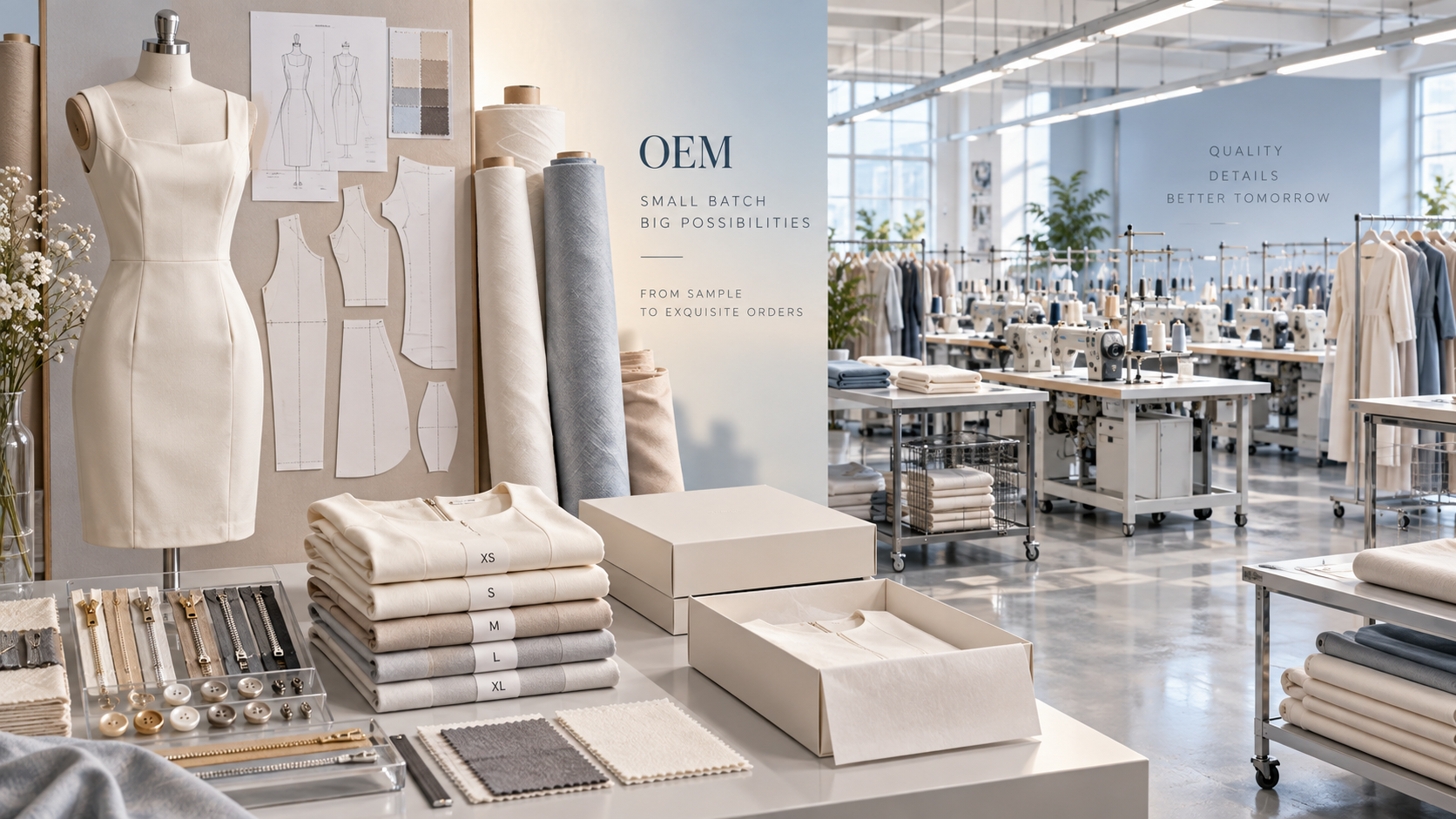
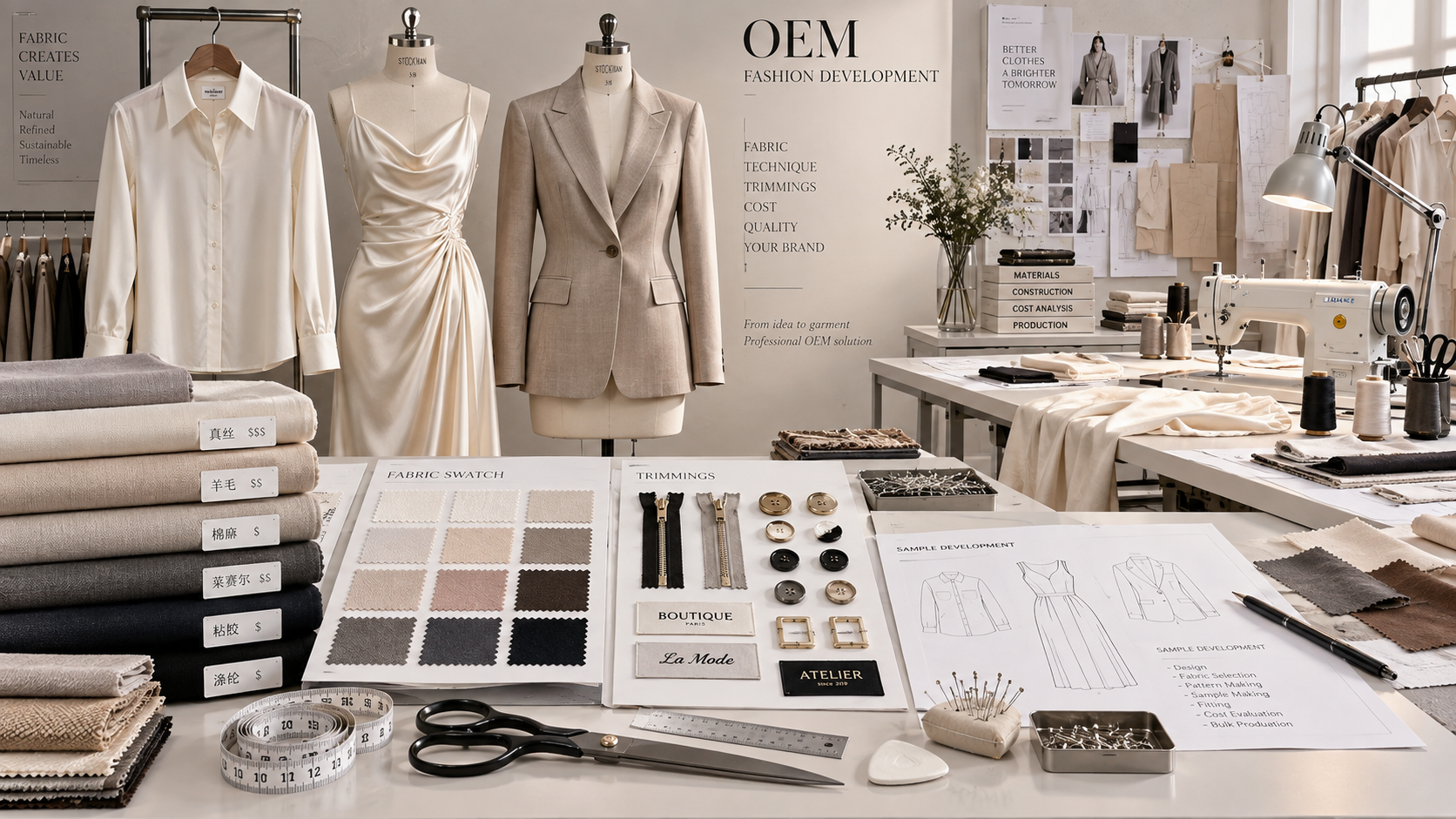
The term OEM is often used broadly, but buyers should clarify the level of customization they need. True OEM work generally means producing garments to the buyer’s specifications: original sketches, technical packs, measurements, fabric standards, labeling, and packaging requirements. Since the supplier must develop and organize the project around those requirements, MOQ is usually linked to the cost of that work.
ODM is different. The manufacturer may offer existing styles that can be adjusted through colors, fabrics, labels, or minor details. This can reduce development time and may make smaller orders more realistic because the base pattern and production method already exist. Ready-stock purchasing is different again: it is typically the fastest route to lower inventory commitments, but provides the least exclusivity and design control.
There is no universally superior route. A brand focused on a distinct identity may need OEM despite a higher initial threshold. A multi-channel retailer testing a trend-led assortment may find that an existing style with limited customization is the more disciplined choice.
How to Discuss MOQ With a Factory Productively
The fastest way to receive a useful MOQ answer is to provide enough information for the factory to assess the project. A vague request for “women’s dresses” produces a vague response. A preliminary tech pack, reference images, target fabric composition, intended colors, estimated size breakdown, label requirements, target market, and desired delivery window will lead to a more reliable discussion.
It is also wise to ask for alternatives rather than treating MOQ as a fixed yes-or-no barrier. A factory may be able to propose a stock fabric version, merge similar colorways, use existing trims, or recommend an existing block that requires less development. These are commercial decisions, not shortcuts that should compromise the approved sample or quality standard.
Before placing an order, confirm the sample approval process, production tolerances, material substitutions policy, defect-handling process, balance payment terms, labeling responsibilities, carton marks, and inspection requirements. MOQ says very little about whether the final garments will match the intended fit and finish.
Why Integrated Production Capability Matters
For women’s apparel, coordination between design, pattern making, accessories, knitting, and bulk sewing often matters more than a factory’s advertised minimum. When those functions are disconnected, a small order can become difficult to manage because every adjustment passes through multiple parties. Fit revisions may affect fabric consumption; a changed neckline may alter trim requirements; a new sleeve shape may change the sewing sequence.
Shenzhen Meiwuzhi Garment Co., Ltd. operates its own factory in Changping Town, Dongguan, with work covering design, pattern making, accessory production, knitting processing, and bulk garment production. It also cooperates with more than ten factories across Dongguan, Zhongshan, and Suzhou in Guangdong, as well as Suzhou in Jiangsu. That type of production network can be relevant when a collection includes different categories or construction requirements, although feasibility still needs to be assessed style by style.
Its related businesses include Shenzhen Taolaichu Network Co., Ltd. and Shenzhen Taoshangpin Network Co., Ltd. The Tchu showroom in Nanshan District, Shenzhen, displays recent ready-stock styles produced by Taolaichu for clothing retailers and online wholesalers. Over 12 years on Alibaba, Taolaichu has recorded sales exceeding RMB 350 million and worked with more than 130 physical stores nationwide, alongside over 45,000 online WeChat business partners and online-store clients. Those figures describe an established domestic distribution presence; they should not be read as a substitute for project-specific production confirmation.
The Practical Answer: Start With a Production-Ready Brief
The minimum order quantity for women’s clothing OEM is ultimately the smallest run that can support the chosen fabric, construction, color plan, trims, quality requirements, and factory workflow without creating unreasonable cost or execution risk. It may be lower for an existing pattern and available materials. It may be considerably higher for a fully original fashion piece with custom components.
Rather than selecting a supplier based only on the lowest quoted MOQ, send the same clear brief to potential manufacturing partners and compare their questions. A serious factory will ask about fit, materials, colors, grading, finishing, compliance needs, and packaging before committing to a number. That conversation is usually a better indicator of a workable OEM relationship than an attractive minimum stated too early.
Previous:No more content
Next:No more content

Do Women’s Clothing OEM Factories Accept Small Boutique Orders?
Do women's clothing OEM factories handle small boutique orders? Learn how MOQ, fabrics, sampling, pricing, and quality control shape a reliable boutique production launch.
How Much Does Women’s Clothing OEM Typically Cost Per Unit?
How much does women's clothing OEM typically cost per unit? Explore practical price ranges, key cost drivers, MOQ impact, and smart sourcing tips to protect quality and profit margins.
Should Buyers Choose Women’s Clothing OEM or Ready Stock?
Is it better to use a women's clothing OEM or buy ready stock? Compare cost, speed, control, and risk to choose the right sourcing strategy for your fashion brand.

{item.title}
{item.description}
Please give us a message
Contact Us