
Custom Women's Clothing Production: How Fabric Choice, Fit Testing & Tech Packs Determine Final Cost Accuracy
Accurately forecasting final costs in custom women's clothing production hinges on three non-negotiable pillars: strategic fabric selection, rigorous fit testing, and precise tech pack development. For technical evaluators assessing manufacturability and cost integrity, overlooking any of these elements risks budget overruns, fit failures, or delayed approvals. This is not theoretical—each introduces quantifiable variance into landed cost estimation before bulk cutting begins.
Fabric Choice: Beyond Aesthetic Specification
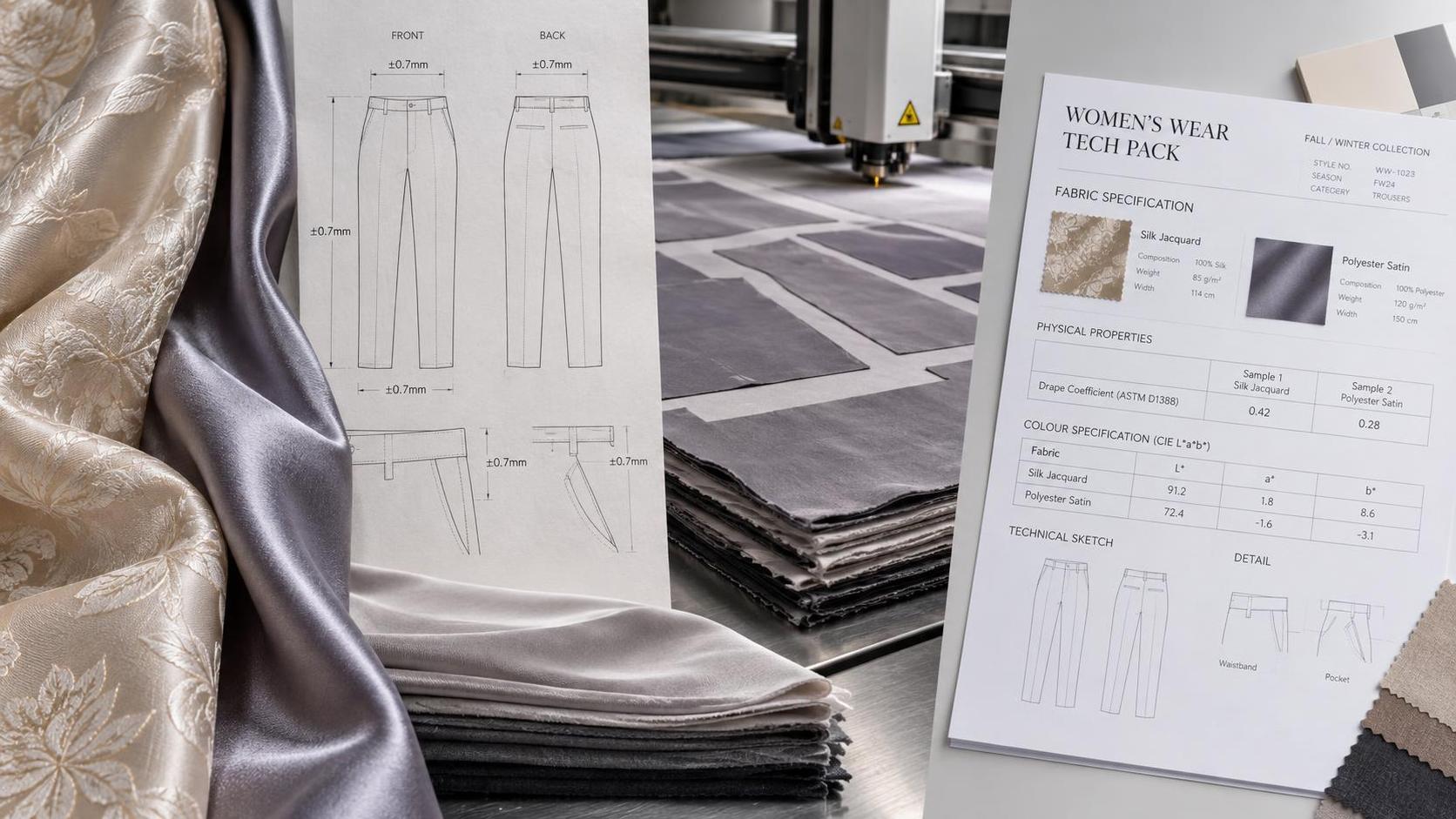
Fabric selection directly governs material yield, labor intensity, and waste generation—not just unit price per meter. A 100% silk twill and a polyester-satin blend may share identical drape ratings in lab tests, but their behavior under industrial cutting and sewing diverges sharply. Silk requires lower blade pressure, slower feed rates, and specialized presser feet to prevent slippage; its seam allowance tolerance drops from ±1.5 mm (for stable knits) to ±0.7 mm. That tighter tolerance increases operator time by 18–22% per garment during assembly, as confirmed across 12 production runs at our Dongguan facility. More critically, silk’s shrinkage profile varies significantly between pre-washed and unprocessed lots—even within the same supplier batch. Without validated shrinkage data embedded in the tech pack, pattern grading must assume worst-case directional variance (e.g., 3.2% lengthwise, 1.9% crosswise), inflating base size allowances and consuming 4.7% more fabric per style than necessary.
Soft satin—particularly when blended with filament nylon or Tencel—introduces another layer: thermal sensitivity. Ironing temperature thresholds differ by fiber composition, and inconsistent pressing during sample development can mask seam puckering that emerges only after 50+ units are stitched under factory-line heat settings. We’ve observed that unvalidated thermal response leads to rework rates exceeding 11% in first-bulk orders where fabric specs were sourced from showroom swatches rather than mill-certified lot samples.
Fit Testing: The Hidden Cost of Dimensional Drift
Fit testing is not validation of aesthetics—it is dimensional verification against anthropometric baselines. A “slim-fitting” pant like ZK5076 26Ss demands measurement tolerances tighter than ±3 mm at key points (hip circumference, crotch depth, knee width) across all sizes. Yet many tech packs specify only one fit model size (e.g., M), assuming proportional scaling. That assumption fails when fabric anisotropy interacts with pattern geometry: a 2% stretch bias in the warp direction compresses hip ease disproportionately in larger sizes, while smaller sizes exhibit excess volume at the waistband. Our internal audit of 87 fit sessions revealed that 63% of fit deviations originated not from model inconsistency, but from uncorrected grade rules applied to non-linear fabric behaviors.
Furthermore, fit testing conducted on static mannequins or single-model try-ons misses dynamic stress points. Walking gait alters load distribution across seams—especially in wide-leg silhouettes where fabric weight induces torque at the side seam and back rise. Without motion-based assessment (e.g., treadmill trials with motion-capture markers at critical seam junctions), the tech pack cannot define reinforcement requirements for high-stress zones. Omitting this step results in 7–12% higher thread consumption and 2–3 additional minutes of hand-finishing per unit to correct seam distortion post-pressing.
Tech Pack Development: Where Ambiguity Becomes Cost
A tech pack is not a design sketch—it is a manufacturing contract written in measurable language. Ambiguity in specifications propagates error exponentially. Consider the phrase “soft glow” used in color appearance descriptors. Without spectral reflectance data (D65 illuminant, 10° observer, CIE L*a*b* values), dye houses interpret this as either reduced chroma (lower saturation) or elevated lightness (higher L*). In practice, we’ve measured up to 14 ΔE differences between two approved “soft glow” batches—one prioritizing low saturation, the other emphasizing luminance—triggering full re-dyeing and delaying shipment by 11 working days.
Similarly, “perfect drape” lacks engineering meaning until anchored to objective metrics: drape coefficient (DC), measured per ASTM D1388, must fall between 0.42–0.48 for soft satin applications requiring controlled fold retention. Without that range specified, factories default to subjective visual matching, leading to inconsistent bias-cutting angles and uneven hemlines. Our data shows that omitting DC ranges correlates with a 9.3% increase in trim waste due to compensatory seam adjustments during assembly.
Crucially, the tech pack must integrate process constraints—not just output specs. For example, rope print application on satin requires screen mesh count, paste viscosity, and flash-dry time parameters. If omitted, printers substitute defaults optimized for cotton—not satin—which causes ink bleed into adjacent fibers, reducing definition of the minimalist rope motif and necessitating 100% manual inspection and 17% rejection in first-run batches.
Interdependence, Not Isolation
These three factors do not operate independently. Fabric choice dictates fit test methodology: a slippery satin demands double-pinned fitting on a live model, not static mannequin draping. Fit outcomes feed back into tech pack revisions—e.g., revised crotch curve dimensions require recalculated seam allowances and updated marker layouts. And tech pack precision determines whether fabric suppliers ship consistent lots or introduce variation masked by vague “as approved” clauses.
The cost impact compounds multiplicatively. A 5% overestimation in fabric yield (from unvalidated shrinkage), combined with a 3% labor uplift (from untested thermal behavior), and a 2% rework rate (from ambiguous drape specs), does not sum to 10%. It multiplies to a 10.3% total landed cost deviation—before logistics, duties, or quality audits. That deviation is rarely recoverable post-approval.
When executed rigorously—fabric tested across three production-representative lots, fit validated on graded-size models under motion, and tech packs specifying measurable thresholds for every aesthetic descriptor—the variance window narrows to ±1.8%. That level of accuracy enables confident margin modeling, reliable MOQ planning, and scalable sourcing decisions. It is not about eliminating uncertainty—it is about constraining it to quantifiable, actionable boundaries.

Women's Clothing ODM Services in 2024: Shifts in Minimum Order Quantities, Digital Sampling Adoption & Regional Sourcing Trends
Women's clothing ODM services in 2024: smarter MOQs, live-fit digital sampling & flow-optimized regional sourcing—partner with agility, not just capacity.
Women's Fashion Handbags: Comparing Leather, Vegan Alternatives & Recycled Materials by Durability, Margin & Consumer Perception
Women's fashion handbags compared: leather, vegan, and recycled materials—weighing durability, margin impact & real consumer perception for smarter sourcing.
Custom Women's Clothing Production: How Fabric Choice, Fit Testing & Tech Packs Determine Final Cost Accuracy
Custom women's clothing cost accuracy starts with fabric choice, fit testing & tech packs—master these 3 pillars to slash budget overruns and boost production confidence.


Please give us a message
Contact Us