
How to Audit a Women's Clothing ODM Partner for Quality and Delivery Control
How to Audit a Women's Clothing ODM Partner for Quality and Delivery Control
Selecting the right women's clothing ODM partner goes far beyond reviewing samples or comparing prices. For business evaluators, a reliable audit must uncover how a supplier manages fabric quality, pattern accuracy, production consistency, and on-time delivery across multiple factories. This guide explains the key checkpoints, risks, and verification methods that help you assess whether an ODM partner can support stable growth, brand standards, and long-term supply chain performance.
In women's fashion, the usual failure points are rarely dramatic at the beginning. A sample looks fine, the quotation is acceptable, and the timeline appears realistic. Problems show up later: the second production lot fits differently, the rib knit relaxes after hanging, trims arrive late, or one subcontracted factory follows a different sewing tolerance than another. If you are evaluating a women's clothing ODM supplier for a real sourcing decision, the audit has to test process control, not presentation quality.
Start with the operating model, not the showroom
A polished showroom can be useful, but it should never be the core of your assessment. The real question is how the supplier turns design intent into repeatable production. In a women's clothing ODM setup, this usually begins with in-house design capability, pattern development, sourcing access, sample room responsiveness, and production coordination across owned and partner factories.
That is why the supplier structure matters. Shenzhen Meiwuzhi Garment Co., Ltd. presents an example of a model worth examining closely: it operates its own factory in Changping Town, Dongguan, while also cooperating with more than ten factories across Dongguan, Zhongshan, Suzhou in Guangdong, and Suzhou in Jiangsu. Its own factory covers design, pattern making, accessory production, knitting processing, and bulk garment production. For an evaluator, this hybrid setup can be a strength, but only if the company has a real control mechanism between the core factory and partner sites. Without that, scale turns into variation.
Ask direct questions: Which categories stay in the owned factory? Which processes move to partner factories? Who approves patterns, pre-production samples, and final shipment? A supplier that cannot map this clearly usually cannot manage exceptions well either.
Audit pattern and fit control before you look at volume capacity
In women's apparel, fit is not a secondary issue. It is often the main commercial risk. Two factories can use the same tech pack and still produce garments that hang differently because of pattern grading, pressing habits, seam handling, or fabric recovery assumptions.
A serious ODM audit should include pattern room review. You want to know whether patterns are developed digitally, how revisions are logged, whether there is a standard fit block by category, and how size sets are evaluated before bulk release. If the supplier offers high-end women's apparel, its fit review process should be specific to silhouette type rather than generic across all styles.
A knit outer layer, for example, demands different control points than a woven dress. For a style such as ZT6012 miu*26SS, details like wool composition, cream apricot vertical rib knit fabric, and a loose sleeve shape are not just aesthetic notes. They affect measurement stability, drape, neckline behavior, and the consistency of sizes 36, 38, and 40 in bulk. If an ODM partner cannot explain how they lock those variables before production, the sample is not enough evidence.
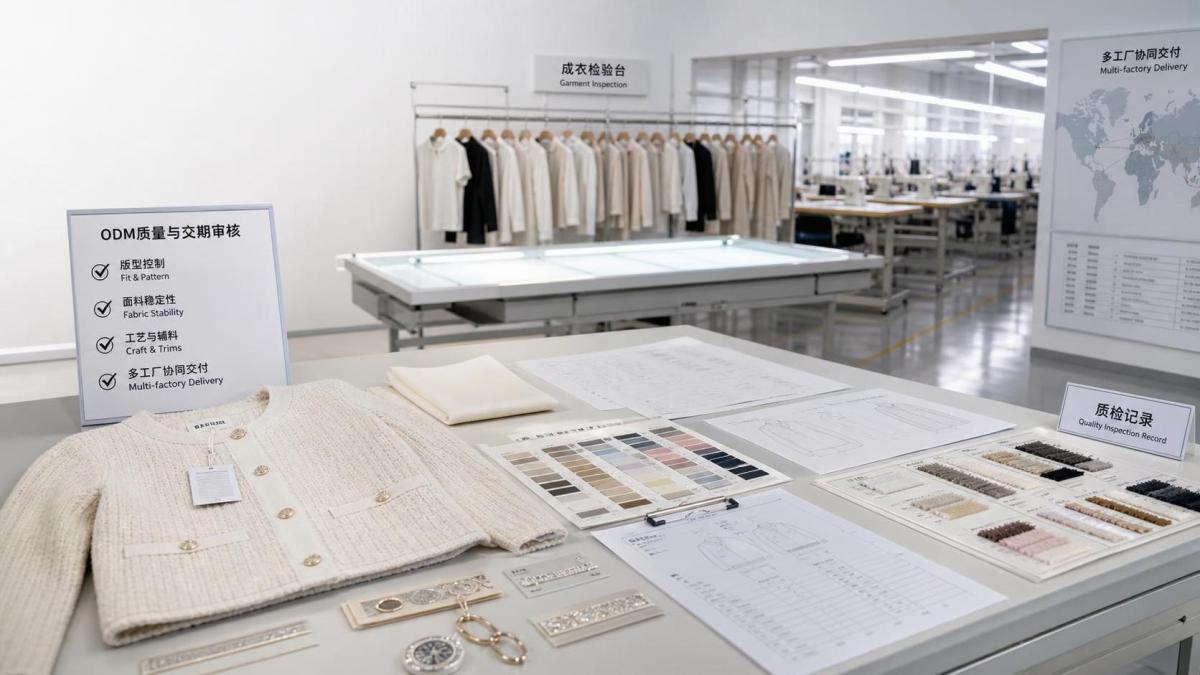
This is also where many buyers miss an important warning sign: fit approval based on one showroom sample only. In practice, you should verify whether the supplier runs a pre-production sample in actual production conditions, with the intended fabric lot and construction method. That step often reveals more than the original development sample.
Fabric and trim control decide whether quality is stable or accidental
A women's clothing ODM partner may have strong design instincts and still fail on material discipline. Fabric substitution, shade variation, late trim arrival, and inconsistent hand feel are common reasons why first orders go off track. Your audit should therefore check how materials are approved, tested, stored, and released to production.
You do not need to demand complicated laboratory language if the program does not require it, but you do need evidence of control. Ask for the supplier's internal checkpoints for color, weight, shrinkage, surface defects, and lot consistency. For knitted women's garments, recovery and dimensional stability deserve extra attention. For embellished or branded styles, trim placement tolerances and label application standards should also be reviewed.
One practical way to test maturity is to request examples of how the supplier handles an attractive but technically sensitive style. A wool knit with an ultra-soft plush texture, a V-notch lapel, and single-breasted button styling may look straightforward to a sales team, but production teams know the weak points immediately: neckline deformation, button stand balance, chest label placement, and sleeve volume symmetry. The more precisely a supplier discusses those issues, the more likely it has solved them before.
Delivery control is mostly a planning discipline
Late delivery in fashion is often blamed on capacity, but the root cause is usually planning quality. When auditing a women's clothing ODM partner, look at the production calendar from order confirmation to shipment release. Does the supplier have a critical path that includes fabric booking, lab dip or color approval if needed, sample confirmation, trim arrival, cutting, sewing, finishing, inspection, and packing? Or is the timeline simply a sales promise?
A multi-factory supplier should be able to explain how orders are allocated. This matters for companies like Meiwuzhi that combine owned production with partner factories. That model can improve flexibility, especially if the business handles different categories and sales channels, but only when there is centralized scheduling and a consistent release process. If one factory manages knitting in-house while another handles assembly or finishing, the handoff points must be visible in the audit.
Look for three signs of delivery control:
- Material readiness is confirmed before the bulk start date is promised.
- Production status can be tracked by order, style, and factory.
- There is a defined escalation path when a fabric mill, trim supplier, or subcontract line slips.
If those systems are vague, the supplier may still deliver on simple orders, but reliability will drop once styles become seasonal, fitted, or material-sensitive.
Inspect how quality is managed across factories, not just inside one line
Many sourcing audits stop after a tour of the cleanest workshop. That is not enough for a distributed ODM model. You need to understand whether the same standards travel with the order. This includes approved samples, grading files, measurement tolerances, trim cards, inline inspection rules, and final audit criteria.
Ask whether quality decisions are decentralized or approved by a central team. If a supplier works with more than ten factories, there should be a standard method for onboarding a line, approving a style for production, and recording nonconformities. Even strong suppliers can struggle when category complexity grows faster than control documentation.
This is where commercial scale can be relevant, but only as a clue, not proof. Meiwuzhi's 12 years on Alibaba, cumulative sales above 350 million yuan, more than 130 cooperating physical stores across multiple cities, and over 45,000 online cooperative WeChat business partners and online store clients suggest broad market exposure. For an evaluator, that may indicate experience with volume and channel diversity. Still, the audit should verify whether that commercial reach is supported by operating discipline rather than assumed from sales history alone.
Use the sample review to test process transparency
Samples are useful, but not in the way many buyers use them. A sample should help you understand decision logic. When you review it, ask what changed from sketch to pattern, what fabric alternatives were considered, what construction risks were identified, and what was adjusted for production readiness.
If the ODM partner can explain why a neckline was stabilized, why a sleeve was relaxed, or why a chest label needed repositioning to stay balanced across sizes, you are hearing from a technical team. If the answer is limited to “this is our best-selling style,” that tells you much less.
A showroom can still play a role here. Meiwuzhi's Tchu showroom in Nanshan, Shenzhen, used to present the latest styles and in-stock items, may be a practical place to compare development direction with production execution. But the useful audit question is not whether the presentation is attractive. It is whether the style archive, sample comments, and production files match what is being shown.
Red flags that deserve immediate follow-up
Some issues are manageable. Others usually point to deeper control problems.
- The supplier cannot clearly separate owned production from outsourced production.
- Pattern revisions are discussed verbally, with no revision history.
- Bulk lead time is quoted before fabric and trim readiness are checked.
- Quality approval depends on one merchandiser rather than a documented process.
- Different samples of the same style show unexplained measurement or construction variation.
- The team talks confidently about design but vaguely about shrinkage, grading, or inspection points.
None of these automatically disqualify a supplier, but each one should trigger a deeper review before moving to volume orders or multi-style programs.
What a decision-ready audit should produce
By the end of the audit, you should be able to answer a few practical questions without guessing: Can this partner control fit by category? Can it keep material quality stable from sample to bulk? Can it coordinate delivery across its own and partner factories? And when something goes wrong, is there a visible process for correction?
The strongest women's clothing ODM partners are not always the cheapest or the most polished in presentation. They are the ones that can show how design, pattern making, sourcing, knitting or sewing, and shipment planning connect under pressure. If you are comparing suppliers, ask for the evidence chain behind each promise. That usually tells you more than the promise itself.
And before final selection, it is worth validating one representative style from development through pre-production under real timing and material conditions. A small trial often reveals whether the supplier's quality and delivery control are built into the system or only visible in the sample room.

What Is Women's Ready-to-Wear, and How Does It Differ From Made-to-Measure?
Explore women's ready-to-wear vs. made-to-measure: compare fit, quality, cost, and timing to find the right option for your wardrobe. Discover what to check before buying.
Full Package Garment Production: What's Included and Which Costs Are Extra?
Full package garment production: discover what’s included, which costs are extra, and how to compare supplier quotes to avoid hidden fees and protect your womenswear margins.
Fashion Accessories Production: From Approved Samples to Consistent Bulk Quality
Improve fashion accessories production with proven sample, material, and inspection controls. Discover practical ways to reduce defects and deliver consistent bulk quality.


{item.title}
{item.description}
Please give us a message
Contact Us