
Sample-Based Garment Production Workflow: From Tech Pack to Bulk Approval
Sample-Based Garment Production Workflow: From Tech Pack to Bulk Approval
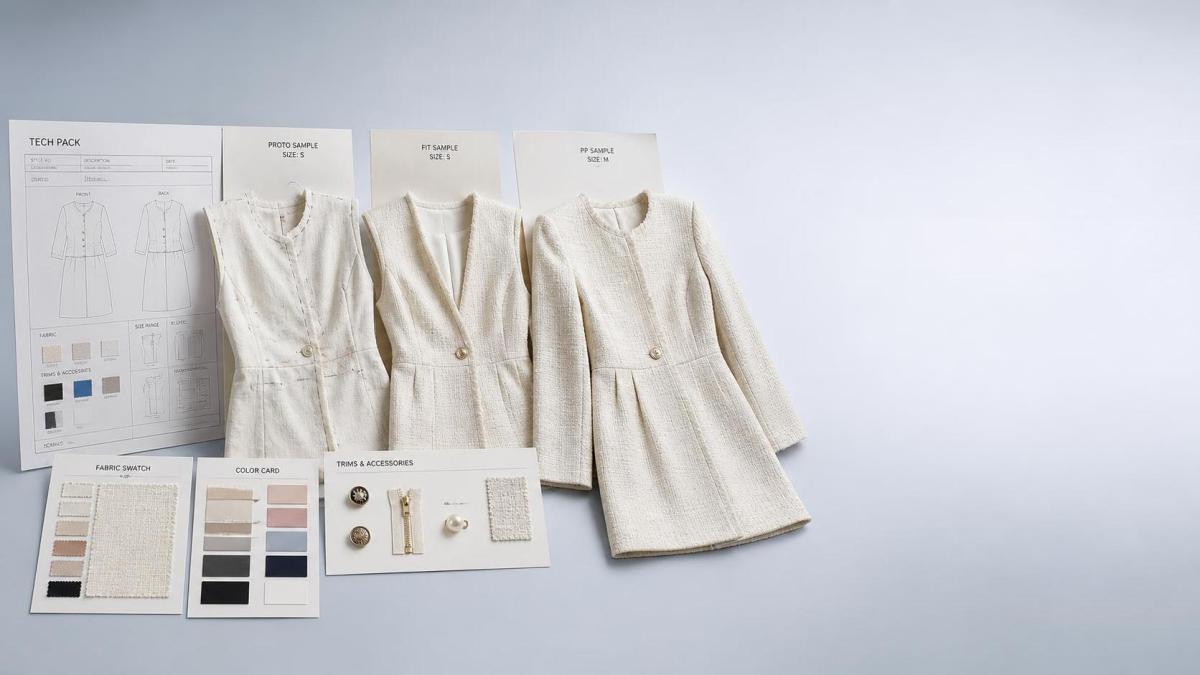
In women’s apparel, the gap between a good sketch and a reliable bulk order is rarely about creativity alone. It is usually about how the sample-based garment production workflow is managed, documented, challenged, and corrected before the line goes live. Technical evaluators know this well: most costly problems do not begin in bulk sewing. They begin much earlier, when a tech pack leaves room for interpretation, when the first sample is reviewed too casually, or when fit comments are approved without checking what they do to construction, consumption, and repeatability.
A disciplined workflow matters even more when production is spread across multiple capabilities. Shenzhen Meiwuzhi Garment Co., Ltd., for example, combines in-house design, pattern making, accessory development, knitting processing, and bulk garment production through its own factory in Changping, Dongguan, while also coordinating with more than ten partner factories across Dongguan, Zhongshan, Suzhou in Guangdong, and Suzhou in Jiangsu. In that kind of setup, sampling is not a formality. It is the control point that keeps style intent, fit, and manufacturability aligned across teams.
The practical question is not whether to sample, but what each sample must prove before the next stage starts.
The tech pack is only useful when it removes ambiguity
A lot of production delays get blamed on factories, but many are really documentation problems. A tech pack that looks complete can still be weak if it does not define tolerance logic, seam construction, grading expectations, fabric behavior, trim placement, wash effects, or labeling standards clearly enough for another team to execute without guessing.
For technical review, the first checkpoint is whether the package supports decision-making at the sample room level. That means at minimum: measurement chart with point-of-measure definitions, construction details, bill of materials, artwork files, size base, fit intent, and any special handling notes. In high-end women’s apparel, the fit intent matters more than many buyers expect. “Relaxed” can mean dropped shoulder and ease in one brand, but a cleaner silhouette with hidden shaping in another. If that intent is not stated, the sample room will fill the blank with its own experience.
This is where experienced evaluators usually slow down. They check not just whether the page count is enough, but whether critical details can be interpreted in more than one way. A zipper opening with no top-stop reference, piping applied without turn-of-cloth allowance, or a collar stand spec that ignores fabric thickness will all come back later as “sample issues,” even though they started as input issues.
Proto sample: testing the idea before testing compliance
The first sample should not be treated as a pass-fail event. It is a translation stage. At proto level, the real job is to verify silhouette, construction feasibility, and whether the designer’s concept survives actual material behavior.
This becomes obvious in styles that look visually simple but rely on balance. A retro sporty women’s set with a crisp white base, contrast piping, and zipper accents may seem straightforward on paper, but if the piping is too stiff, the front placket may torque; if the body fabric lacks recovery, the hem line may collapse after pressing; if the logo placement sits too close to the seam turn, bulk consistency becomes hard to maintain. A style direction like ZT5616 Miu26SS, which blends tennis club aesthetics with everyday wear, is a good example of why proto review should look beyond appearance. Clean tailoring and “photographs beautifully” styling cues only work when the pattern, trim choice, and sewing method support that finish in repeated production.
At this stage, technical evaluators usually ask a few practical questions:
- Can the intended silhouette be achieved with the actual fabric weight and handfeel?
- Are decorative elements also creating sewing risk or measurement instability?
- Does the sample require operator skill that may be difficult to replicate at scale?
- Will revision of one point, such as neckline depth or armhole shape, affect the rest of the grading logic?
A proto sample is often allowed to be imperfect. What should not be imperfect is the feedback record.
Fit sample review is where many teams lose control
Fit comments are easy to write and easy to misunderstand. “Raise waist,” “reduce fullness,” or “make sleeve cleaner” sound efficient in meetings, but they are not technical instructions. Good fit review converts aesthetic reaction into measurable action. If the bust is acceptable but the front balance is pulling, the correction may be shoulder angle or armhole position, not simply adding width. If the hip is roomy but side seam drifts to front, the issue may be distribution rather than circumference.
For a sample-based garment production process to stay controlled, fit review needs to connect three things at once: visual outcome, pattern adjustment, and downstream impact. A 1 cm change at neckline can change facing roll, topstitch visibility, and label position. Shortening a body to improve proportion can interfere with pocket placement or print registration. These are routine issues, but they are often missed when fit is treated as an isolated approval gate.
This is also why cross-functional capability matters. Meiwuzhi’s in-house handling of pattern making, accessory preparation, knitting processing, and garment production gives a technical advantage during fit correction: revisions can be checked not only by merchandisers or designers, but by the people who understand how trims, fabric response, and sewing sequence interact. That shortens the loop between comment and workable solution.
Pre-production sample approval should prove repeatability, not just beauty
The pre-production sample, or PP sample, is the point where the conversation changes. By then, the style should no longer be under conceptual development. The main question is whether the approved version can be reproduced in bulk under actual factory conditions.
That sounds obvious, but many PP approvals still happen on a sample that was made under unusually careful sample-room conditions, with hand-picked operators, substituted trims, or fabric lots that will not match bulk. Technical evaluators should be wary of approving a PP sample unless the materials, workmanship route, and finishing method reflect production reality closely enough.
A useful PP review often includes these checks:
One common mistake is approving the PP sample while still carrying “small pending points.” In practice, those small points often multiply in bulk: topstitch width shifts, logo placement drifts, pressing shape becomes inconsistent, or trim tone varies from lot to lot. If the style depends on clean visual language—say, contrast striped trim, crisp tailoring, and a soft skin-friendly material in sizes S, M, and L—small pending points are not really small.
Bulk approval depends on line readiness as much as on the sample itself
Bulk approval is often discussed as if it were a document status. In reality, it is an operations decision. Even after a good PP sample, bulk consistency can fail if line setup is not aligned: operator briefing is incomplete, measurement points are interpreted differently on the floor, trim bundles are mixed, or finishing standards are understood one way by QC and another way by production.
Technical evaluators should pay attention to the handoff. Is the approved sample physically available on site as the sealed standard? Are comment sheets version-controlled? Has grading been checked against the approved base size? If there are partner factories involved, are they working from the same revision set, not an older email attachment or translated note?
This is where companies with distributed capacity need discipline. A network can be a strength, especially when one factory is better at knit handling and another at woven tailoring, but only if approval criteria are transmitted without dilution. Meiwuzhi’s long operating history across wholesale and showroom channels, plus its reach through physical retail partners and a large online client base, suggests a business that must keep style consistency under commercial pressure. That only works when sample approval is treated as a manufacturing standard, not just a customer-facing milestone.
What experienced reviewers usually watch for
The most useful technical reviews are rarely the longest. They focus on the points most likely to fail in repetition:
- Construction details that look neat on one sample but are too sensitive to operator variation
- Fit corrections that solve one area while quietly breaking balance somewhere else
- Decorative elements that interfere with pressing, wash performance, or seam stability
- Materials that support styling in the showroom but may not hold the same line after transport or storage
- Comments written in aesthetic language without measurable interpretation
That last point is more important than it sounds. A sample can absolutely look “more premium” or “cleaner,” but unless the team can define why—narrower stitch margin, firmer edge support, improved front balance, better trim proportion—the improvement is hard to control in bulk.
The strongest sample-based garment production systems are not the ones with the most paperwork. They are the ones where each sample has a job, each approval closes a real risk, and each revision is traceable back to a technical reason. If a team can do that consistently from tech pack to PP sample to bulk line release, bulk approval stops being a leap of faith. It becomes a decision supported by evidence.

What Is Women's Ready-to-Wear, and How Does It Differ From Made-to-Measure?
Explore women's ready-to-wear vs. made-to-measure: compare fit, quality, cost, and timing to find the right option for your wardrobe. Discover what to check before buying.
Full Package Garment Production: What's Included and Which Costs Are Extra?
Full package garment production: discover what’s included, which costs are extra, and how to compare supplier quotes to avoid hidden fees and protect your womenswear margins.
Fashion Accessories Production: From Approved Samples to Consistent Bulk Quality
Improve fashion accessories production with proven sample, material, and inspection controls. Discover practical ways to reduce defects and deliver consistent bulk quality.


{item.title}
{item.description}
Please give us a message
Contact Us