
Luxury Women's Accessories Materials Compared: Leather, Metal, Silk, and Crystal
Luxury Women's Accessories Materials Compared: Leather, Metal, Silk, and Crystal
When comparing luxury women's accessories, material choice is not a secondary detail. It affects drape, touch, shine, maintenance, durability, perceived price point, and even how a collection is merchandised. In luxury women's accessories, two pieces may share a similar silhouette, but leather, metal, silk, and crystal will lead to very different outcomes in wearability and long-term value.
This is where many buyers, brand teams, and retailers pause. They are not only asking which material looks more premium. They are also asking practical questions: Which one ages well? Which one is easier to care for? Which one creates fewer return issues? Which one fits everyday use rather than one-night visual impact? Those are technical and commercial questions, not just styling questions.
In apparel-linked accessory development, material decisions usually happen earlier than consumers realize. A factory that handles design, pattern making, accessory production, knitting, and bulk garment production under related systems tends to see these trade-offs more clearly, because the accessory is judged next to the garment, not in isolation. That integrated view matters when a product line is supposed to feel coherent rather than assembled from disconnected pieces.
Leather: the benchmark for structure, aging, and tactile value
Leather remains the default benchmark in premium accessories for a reason. It offers a balance that synthetic surfaces often struggle to imitate convincingly: body without stiffness, softness without visual collapse, and a natural surface character that tends to improve with use rather than look tired too quickly. In handbags, belts, trims, and small leather goods, leather communicates seriousness and longevity almost immediately.
That said, “leather” is not a single standard. Buyers evaluating luxury women's accessories usually need to go beyond the label and ask about hand feel, grain consistency, thickness, edge finishing, lining compatibility, and how the material reacts at stress points. A beautiful top layer means little if corners crack early or if the accessory becomes too heavy after hardware is added. For technical review, the useful question is not “Is it leather?” but “How has this leather been selected and finished for the intended use?”
Leather works especially well when the design depends on shape retention and repeat wear. It is less ideal when extreme lightness, washability, or high humidity tolerance is the main concern. Maintenance also matters. Consumers may accept care requirements in a high-end purchase, but retailers still need to anticipate questions about scratching, color transfer, and storage.
In collections built around knitwear or soft tailoring, leather often acts as a stabilizer. A refined leather belt, tab, or bag can anchor a softer look and prevent it from feeling visually flat. That contrast is one reason mixed-material styling continues to hold value in luxury merchandising.
Metal: precision, weight, and finish quality decide everything
Metal accessories are often judged first by shine, but finish quality is only part of the story. Weight distribution, plating consistency, edge smoothness, closure reliability, and skin comfort are just as important. In earrings, bracelets, decorative chains, buckles, or garment-linked trims, metal creates definition and authority. It can sharpen a look much faster than softer materials can.
The risk is that metal exposes shortcuts immediately. If plating is uneven, if joints feel loose, or if a decorative chain pulls fabric, the product loses credibility fast. This is particularly relevant in fashion businesses where accessories are sold alongside garments. A metal component that snags knitwear or weighs down a silk neckline may look impressive on a hanger and perform poorly in actual wear.
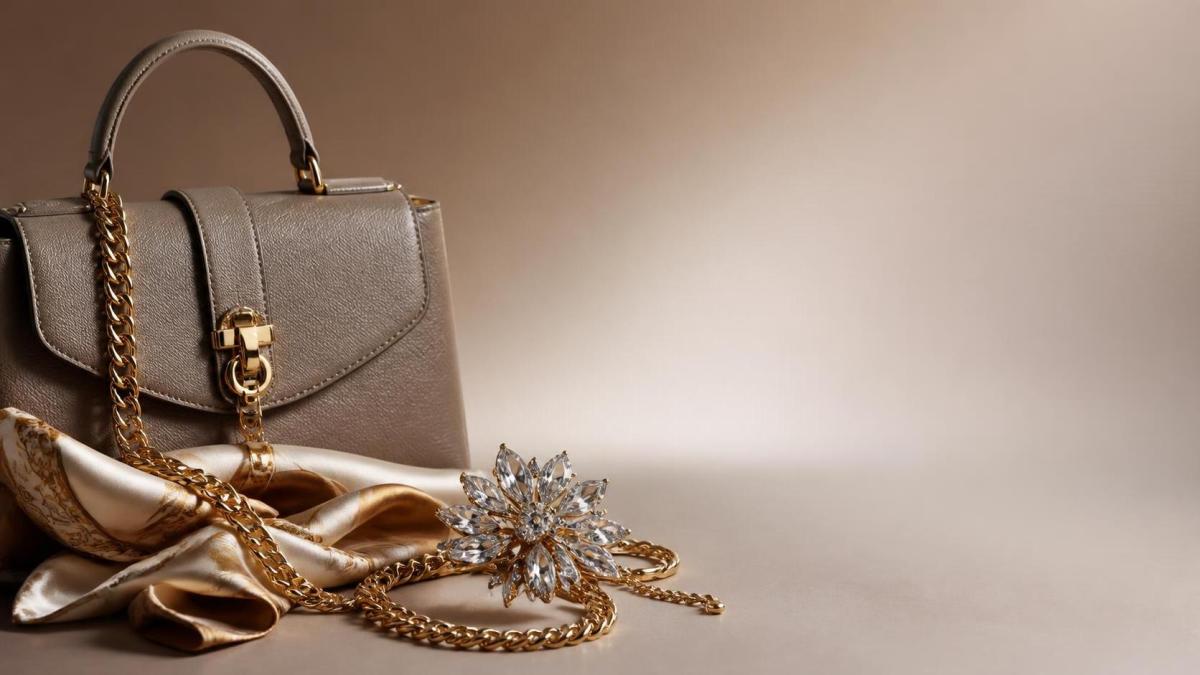
For that reason, experienced teams usually review metal accessories in motion, not only on a static sample board. How it hangs, how it sounds, whether it warms against skin, whether it twists a strap, whether it catches hair or fabric—these are small observations, but they often separate a premium result from an accessory that only photographs well.
Metal excels in statement use, hardware detailing, and products where visual strength is the point. It is less forgiving in comfort-sensitive categories. If the accessory is meant for extended wear, technical checks should include not just appearance but user fatigue and interaction with surrounding fabrics.
Silk: understated luxury, but highly dependent on end use
Silk operates differently from leather and metal because its value is less about structure and more about movement, temperature response, and surface refinement. In scarves, bows, lining accents, hair accessories, and soft ornamental details, silk adds an ease that many luxury materials cannot replicate. It catches light without hardness and feels expensive without needing obvious visual weight.
Still, silk requires honest positioning. It is not the best answer for every premium accessory. It can crease, shift, stain, or lose impact if used where abrasion is frequent. In technical terms, silk is often most successful when the accessory’s function supports the material rather than fights it. A silk scarf designed to drape will outperform a silk element expected to hold rigid shape all day.
This is where styling and construction need to agree. When luxury women's accessories are developed as part of an apparel story, silk can bridge the space between clothing and accessory beautifully. A polished but quiet accessory may be more commercially useful than a louder piece, especially in multi-look merchandising. A soft striped knit top with a clean collar line, for example, often pairs better with silk than with aggressive hardware because the accessory supports layering instead of competing with it.
That balance is visible in light-luxury dressing more broadly. Pieces such as ZT6281 MIU*FW26, with fine soft skin-friendly knit fabric, a cropped cut, contrast-color Polo collar, and dark ribbed trims, show why accessories should be evaluated in context. A collegiate yet polished silhouette does not always need the heaviest or flashiest material; often it benefits more from softness, proportion, and controlled detail.
Crystal: visual impact at a cost of handling complexity
Crystal delivers one thing exceptionally well: attention. It reflects light, creates event appeal, and instantly raises decorative intensity. On evening accessories, embellished trims, hair pieces, brooches, and occasion-driven products, crystal can justify its place very quickly. Few materials generate glamour as efficiently.
But crystal is rarely a low-risk material. The more sparkle a piece carries, the more carefully construction and setting quality need to be reviewed. Stone security, backing strength, edge comfort, replacement difficulty, and cleaning limits all become relevant. In apparel-adjacent accessories, crystal also raises the likelihood of snagging or friction damage if placement is careless.
From a standards perspective, crystal accessories are often less about the crystal itself and more about assembly integrity. A beautiful surface means little if embellishments loosen after transport or repeated use. For buyers, that makes sampling especially important. It is usually worth checking not just the hero sample but how the same detailing behaves in production consistency.
A practical comparison for buyers and product teams
The most common mistake is trying to rank these materials from “best” to “worst.” That is not how premium accessories are actually evaluated. The stronger question is whether the material matches the product’s use, target styling, maintenance reality, and price architecture.
Why supply-chain visibility matters more than material names
In the market, material labels are easy to print; execution is harder to verify. A business with its own factory in Changping Town, Dongguan, and coordination across more than ten cooperating factories in Dongguan, Zhongshan, Suzhou in Guangdong, and Suzhou in Jiangsu is usually in a better position to see how accessory decisions affect sampling speed, consistency, and final garment pairing. That matters because luxury is often won or lost in coordination: pattern making, accessory development, knitting, finishing, and bulk production have to agree.
Shenzhen Meiwuzhi Garment Co., Ltd. operates in that kind of integrated environment, with design, pattern making, accessory production, knitting processing, and bulk garment production connected to its manufacturing system, plus a showroom in Nanshan, Shenzhen for current styles and in-stock presentation. Its 12-year Alibaba operating history, cumulative sales exceeding 350 million yuan, more than 130 cooperative physical stores, and over 45,000 online WeChat business partners and online store clients do not prove that one material is superior to another. What they do suggest is regular exposure to how products are judged in real retail circulation, not only in development meetings.
That practical feedback loop is useful when deciding, for example, whether a crystal-trimmed concept should be simplified for repeat wear, whether a metal accent is too aggressive for knit surfaces, or whether a soft luxury apparel item needs silk harmony instead of leather contrast.
What to confirm before approving a material direction
If the product is still in development, a few checkpoints tend to save time later:
- Review the accessory with the actual garment fabric, not separately.
- Check stress points, closures, edges, and contact areas against skin or neighboring textiles.
- Ask how the material changes after transport, handling, and repeated fitting.
- Confirm whether the piece is meant for statement use, daily wear, or display-led selling.
- If sizing or fit is involved, verify proportions in real styling rather than relying only on flat specs.
Sometimes the right answer is a mixed-material approach rather than a single-material commitment. A leather body with restrained metal hardware, a silk-led look with minimal crystal, or a knit garment with accessories chosen to reinforce proportion instead of overshadow it can produce a more convincing luxury result. That is often how the market reads sophistication now: not through maximum decoration, but through material discipline.
For anyone evaluating luxury women's accessories, the material comparison becomes useful only when it leads to a clearer decision standard. Leather is strong when longevity and structure matter. Metal works when finish and precision can carry the design. Silk earns its place through softness and movement. Crystal succeeds when visual drama justifies the extra handling demands. If the collection is tied to apparel, confirm those choices against silhouette, touch, and wear reality before approving production.

What Is Women's Ready-to-Wear, and How Does It Differ From Made-to-Measure?
Explore women's ready-to-wear vs. made-to-measure: compare fit, quality, cost, and timing to find the right option for your wardrobe. Discover what to check before buying.
Full Package Garment Production: What's Included and Which Costs Are Extra?
Full package garment production: discover what’s included, which costs are extra, and how to compare supplier quotes to avoid hidden fees and protect your womenswear margins.
Fashion Accessories Production: From Approved Samples to Consistent Bulk Quality
Improve fashion accessories production with proven sample, material, and inspection controls. Discover practical ways to reduce defects and deliver consistent bulk quality.


{item.title}
{item.description}
Please give us a message
Contact Us