
Women's Clothing OEM Pricing Explained: What Buyers Pay for at Each Stage
Understanding women’s clothing OEM pricing helps buyers control budgets, compare suppliers, and avoid hidden costs. From design and sampling to fabric sourcing, trims, production, and quality control, every stage affects the final quote. This guide breaks down what procurement teams actually pay for in women’s clothing OEM projects, so you can make smarter sourcing decisions and negotiate with greater confidence.
For procurement teams, the biggest mistake is treating an OEM quote as if it were just a unit price. In women’s apparel, especially in fashion-driven categories, the quoted FOB or EXW number is only the visible result of many smaller cost decisions made upstream. Two factories may offer similar prices for the same sketch, but the difference often lies in pattern accuracy, fabric substitution risk, trim quality, sewing tolerance, finishing standards, or rework probability. That is why a low quote can become an expensive order.
In practice, women’s clothing OEM cost is built in layers. Some costs are obvious and appear in the proforma invoice. Others are embedded in yield assumptions, order complexity, or supplier behavior. Buyers who understand those layers are in a much better position to evaluate whether a supplier is genuinely competitive or simply underquoting to win development.
OEM pricing starts before bulk production
Many buyers focus on bulk manufacturing cost, but the first meaningful spend usually appears in development. In women’s clothing, design interpretation is rarely straightforward. A supplier may receive a tech pack, a physical sample, a mood board, or only reference photos. The less complete the development input, the more engineering work the factory must absorb.
That work can include pattern making, size grading, construction review, stitch planning, fabric behavior assessment, and fit adjustment. If the garment has drape, shaping, pleating, special wash effects, lining structures, or decorative details, the supplier’s development team will spend more hours before production can even be planned.
Buyers are effectively paying for three things at this stage:
- translation of concept into a manufacturable garment;
- risk reduction before mass production;
- supplier time from pattern room, sample room, and sourcing staff.
Some factories charge sample development separately. Others reduce or waive part of the cost if bulk orders are confirmed. Either way, this cost exists. It is simply either visible or hidden.
Sample charges are not only about making one piece
Procurement teams often push back on sample fees because they compare them to expected production unit cost. That comparison is misleading. A sample is expensive not because of material consumption, but because it interrupts the normal production flow and concentrates skilled labor into a one-off job.
A women’s dress sample may require:
- custom pattern drafting;
- manual cutting rather than marker-based bulk cutting;
- substitute trims sourced in small quantities;
- multiple fit revisions;
- photo confirmation and spec updates;
- pressing and presentation-level finishing.
If the garment is trend-sensitive or brand-led, the sample may also need a closer aesthetic match. For example, a style inspired by polished contemporary preppy dressing—such as a sleeveless shirt dress with gold-tone buttons, a matching belt, lapel structure, and an A-line silhouette like ZL5165 Miu* 2026—may look simple in a showroom, but reproducing its balance of structure, drape, and trim harmony requires development judgment. Those hidden hours are often what buyers are paying for more than the single prototype itself.
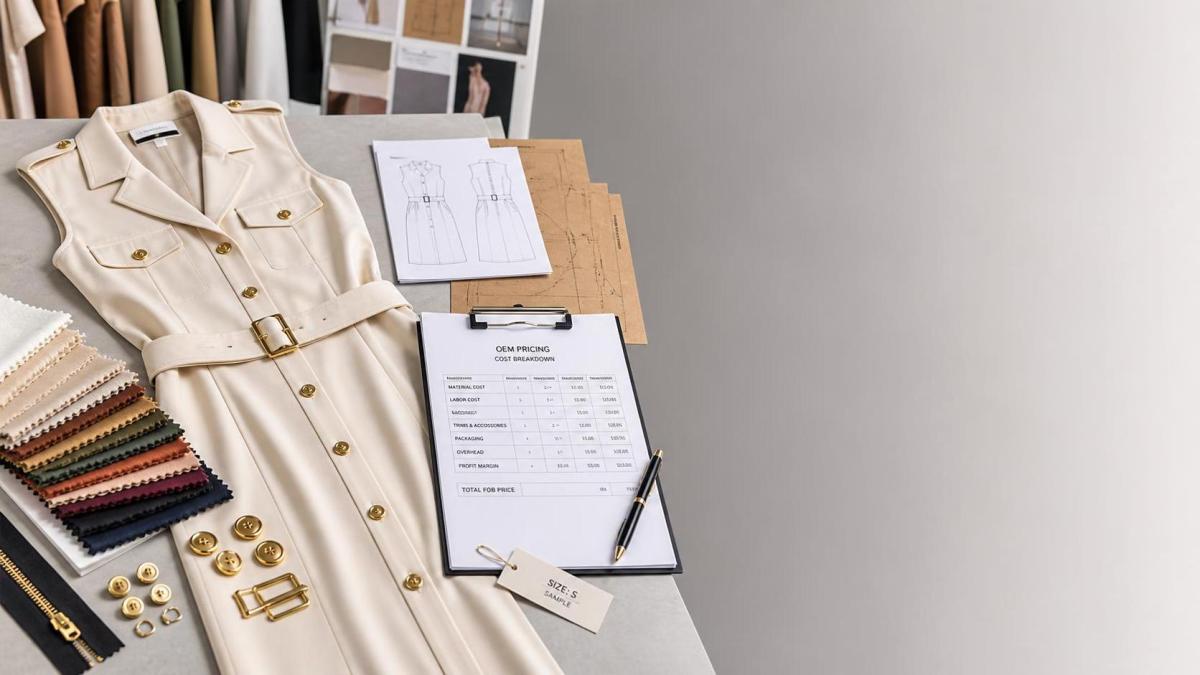
Sampling becomes more expensive when the buyer requests repeated changes without locking specs. That is common in women’s clothing OEM because fit, hand feel, and silhouette often change after the first sample review. If your internal team has not aligned on neckline depth, length tolerance, fit block, button finish, or fabric weight, the supplier may need to remake the sample multiple times. Procurement then faces “unexpected” development invoices that were entirely predictable from the process.
Fabric is usually the biggest cost driver, but not in the way buyers assume
Most buyers know fabric is a major part of garment cost. What they sometimes underestimate is how many variables sit behind a fabric line item. Price per meter or per kilogram is only the start.
Fabric cost is shaped by:
- fiber composition;
- construction and weight;
- dyeing or printing method;
- minimum order quantity from the mill;
- lead time and replenishment flexibility;
- shrinkage and defect rate;
- fabric width and marker efficiency.
A cheaper fabric can increase final garment cost if it has unstable shrinkage, poor colorfastness, excessive skew, or weak recovery. In women’s fashion, appearance matters as much as compliance. If the selected material cannot hold the intended silhouette or drape correctly after washing or pressing, the factory may need additional process controls, or the buyer may face claims after delivery.
Another common pricing misunderstanding concerns consumption. Buyers sometimes benchmark supplier quotes using rough fabric usage estimates, but actual consumption depends on size ratio, pattern shape, width utilization, and whether matching is required. Stripes, plaids, directional prints, nap fabrics, and engineered placement all reduce marker efficiency. That increases cost even if the nominal fabric price is unchanged.
When procurement compares quotations, it is worth asking not just for fabric price, but for the assumed consumption basis, expected wastage, and whether testing costs are included. Without that, quote comparisons are not apples to apples.
Trims and accessories can distort total cost faster than expected
In women’s garments, trim strategy often separates entry-level OEM from premium OEM. Buttons, zippers, interlinings, labels, elastics, hook-and-eye sets, shoulder pads, lace, belts, embroidery threads, packaging, and hangtags may each seem minor. Combined, they can materially change both cost and execution risk.
Buyers are not only paying for the accessory itself. They are also paying for:
- supplier sourcing time;
- matching consistency across production lots;
- minimums imposed by trim vendors;
- replacement and backup stock;
- attachment labor and defect risk.
Custom trims increase this effect. A gold button with a custom mold, a logo embroidery placement, or a matched fabric belt can elevate product value, but it also adds tooling, approval cycles, and replenishment complexity. On short runs, these costs are disproportionately high because the development expense is spread over fewer units.
This is one reason why highly visual garments often show larger quote variations between suppliers. One factory may source standard substitutes to keep price low. Another may quote to your exact aesthetic requirements. The cost difference reflects specification discipline more than manufacturing inefficiency.
Cut-make-trim pricing depends heavily on construction complexity
When buyers ask what the factory “charges for making,” they are usually referring to CMT or assembly cost. In reality, this is where supplier capability becomes visible. Women’s apparel is labor sensitive. The complexity of operations can change sewing minutes significantly even when two garments look similar on a line sheet.
Construction cost rises with factors such as:
- number of panels and seams;
- lining or partial lining;
- shirring, pleats, tucks, or gathers;
- plackets, collars, cuffs, and welt details;
- invisible zippers or difficult closures;
- topstitch accuracy requirements;
- fit-sensitive operations around bust, waist, and hip.
A simple sleeveless woven dress may be cost-effective in one version and considerably more expensive in another depending on whether it includes collar construction, button plackets, waist belts, embroidery, or shape-control finishing. Buyers who compare CMT based only on garment category—“dress versus dress”—often miss where the time is actually spent.
There is also a scale effect. Small runs usually carry higher CMT because line setup, operator balancing, and quality risk are spread over fewer units. Factories with stronger women’s wear specialization may quote higher labor rates but deliver more stable efficiency and lower rework. For procurement, that can be the cheaper total option.
Printing, embroidery, washing, and finishing are separate economic events
Special processes are often treated as add-ons, but from a sourcing perspective they are independent cost centers with their own lead times and failure points. Embroidery, garment washing, heat transfer, pleating, beading, bonding, foil, or special pressing treatments each create process dependencies beyond the sewing floor.
What buyers are paying for here includes not just decoration, but process coordination. If the embroidery panel shifts, if wash shade differs between lots, or if pressing distorts a fused area, the entire garment may require rework or replacement. That risk is reflected in the quote, especially when the factory must outsource the process to a nominated partner.
This matters in women’s clothing OEM because fashion styling often relies on finish details to create perceived value. A garment may be technically easy to sew but expensive to finish consistently at scale.
Quality control is not free, even when it is not listed
Many buyers ask suppliers to include inspection, but few ask what level of control is assumed. Inline checks, end-line inspections, measurement verification, needle control, metal detection where relevant, packaging checks, and final AQL inspection all consume labor and time. If the order requires higher appearance consistency, stricter measurement tolerances, or third-party inspection support, the supplier’s cost base rises.
Factories with better internal quality systems may not always show the cheapest unit price, but they usually reduce downstream costs: fewer claims, less rework, lower airfreight replacement risk, and less strain on the buyer’s merchandising team.
For procurement, the key question is not whether QC is included. The better question is: what kind of QC is included, and what defect assumptions sit behind the quote?
Packaging, compliance, and logistics can quietly erase a “good” price
Once the garment itself is priced, buyers still need to evaluate packing and shipment assumptions. Individual polybags, recycled packaging requirements, barcode stickers, size separators, branded cartons, carton drop-test standards, and retailer-specific packing ratios can all affect final cost.
Compliance costs should also be reviewed carefully. Depending on the target market, buyers may require fabric testing, colorfastness verification, restricted substance screening, labeling compliance, flammability-related review where applicable, or social compliance documentation. Regulatory requirements vary by destination and product category, so any specific standard should be confirmed against the latest importer and market rules 【待核实】.
Logistics-related pricing is another source of confusion. Some OEM quotations include only ex-factory price. Others include local transport to port, export packing, or FOB charges. Comparing these without adjusting the commercial basis leads to poor supplier selection.
Why low MOQ orders almost always look expensive
In women’s fashion, buyers often need lower quantities for testing, seasonal capsules, or fast market entry. Suppliers can support this, but not at the same cost structure as established repeat orders. Development, sourcing, cutting loss, trim minimums, and line setup do not shrink in proportion to volume.
This is why low MOQ women’s clothing OEM projects often carry:
- higher unit prices;
- less trim customization;
- fewer size/color combinations;
- tighter payment expectations;
- longer confirmation cycles for materials.
Buyers should not read this automatically as poor competitiveness. It is often just the mathematical reality of small-batch manufacturing. The better negotiation path is usually not to push blindly for a lower unit cost, but to simplify specifications, consolidate colors, use stock-supported fabric options, or combine styles under shared materials.
How experienced buyers compare OEM quotes properly
The most reliable quote comparison method is to break the offer into stages and assumptions. At minimum, buyers should clarify:
- development and sample fee structure;
- fabric source, composition, MOQ, and consumption basis;
- trim specification versus substitute allowance;
- CMT assumptions tied to construction details;
- special process pricing and outsourcing arrangement;
- inspection scope and quality tolerance expectations;
- packing method and labeling requirements;
- trade term basis: EXW, FOB, or otherwise.
If one supplier is materially lower than others, the right response is not immediate celebration. It is investigation. Has the supplier priced against a lighter fabric? Have they excluded testing? Are they assuming standard buttons instead of custom hardware? Is the quote based on one size set rather than full grading? Is there an unspoken expectation that the first bulk will absorb development loss?
These are normal issues in sourcing, not signs of bad faith by default. But they need to be surfaced before PO placement.
What procurement teams should negotiate at each stage
The strongest negotiations in apparel OEM are not only about price cuts. They are about cost transparency and risk allocation.
During development, buyers should negotiate sample charge credit-back conditions and the number of revisions included. During material sourcing, they should lock approved substitutions and define liability for off-shade or late trim arrival. During bulk production, they should align on tolerance, rework handling, and delivery consequences. Before shipment, they should confirm inspection standards and carton requirements in writing.
Good suppliers generally accept this level of detail because it reduces disputes later. It also helps both sides protect margin.
In women’s clothing OEM, the final unit price is less a single number than a compressed record of choices made from concept to shipment. Buyers are paying for design translation, sampling skill, fabric behavior, trim execution, sewing complexity, process control, quality discipline, and delivery readiness. Once procurement teams read quotes through that lens, supplier comparison becomes much more accurate—and negotiations become far more effective.

What Is Women's Ready-to-Wear, and How Does It Differ From Made-to-Measure?
Explore women's ready-to-wear vs. made-to-measure: compare fit, quality, cost, and timing to find the right option for your wardrobe. Discover what to check before buying.
Full Package Garment Production: What's Included and Which Costs Are Extra?
Full package garment production: discover what’s included, which costs are extra, and how to compare supplier quotes to avoid hidden fees and protect your womenswear margins.
Fashion Accessories Production: From Approved Samples to Consistent Bulk Quality
Improve fashion accessories production with proven sample, material, and inspection controls. Discover practical ways to reduce defects and deliver consistent bulk quality.


{item.title}
{item.description}
Please give us a message
Contact Us