
How Custom Women's Clothing Helps Small Brands Launch Limited Collections Faster
How Custom Women's Clothing Helps Small Brands Launch Limited Collections Faster
For small fashion brands, limited collections are often where identity gets defined. They are also where operational weaknesses show up fastest. A capsule line may look simple from the outside, but behind it sit sampling delays, fabric minimums, fit revisions, trim sourcing, and the constant risk of launching too late for the moment that inspired it.
That is why custom women's clothing matters far beyond aesthetics. For decision-makers, it is a practical way to shorten the path from concept to sellable product. When the manufacturing setup is right, custom development gives small brands more control over fit, fabric, branding details, and order quantities without forcing them into the slow cycle that usually comes with mass-market production logic.
Speed, however, does not come from “custom” alone. It comes from how design, pattern making, materials, and production are connected. If those functions are fragmented across too many parties, even a small run can drag on. If they sit in a tighter workflow, a limited collection becomes much easier to test, refine, and release while demand is still fresh.
Why limited collections usually slow small brands down
The usual problem is not lack of ideas. It is conversion. A founder or product manager may know exactly what the collection should feel like, but translating that into patterns, material decisions, grading, and production-ready instructions takes technical depth. For women's apparel, that gap is especially important because fit tolerance, drape, neckline shape, sleeve proportion, and finishing details all affect whether the piece looks premium or disappointing.
Small brands also tend to work with tighter budgets and lower first-order volumes. Many factories are built for larger, standardized runs, so sampling and low-volume customization get pushed to the side. The result is familiar: repeated communication, re-sampling, missed launch windows, and collections that arrive when the buyer's attention has already moved elsewhere.
A custom manufacturing model helps when it reduces those handoff points. Instead of treating design, pattern work, knitting or fabric processing, trims, and bulk production as separate obstacles, the better setup treats them as one continuous process.
What faster custom development actually looks like
In practice, faster launch cycles usually come from a few operational advantages.
First, the factory needs to understand women's silhouettes, not just execute tech packs. A team that can assess drape, fit balance, and visual proportion early will catch issues before they turn into costly sample rounds. That matters more for limited collections, where there is less room to absorb waste.
Second, accessory and material coordination should happen alongside pattern development. If labels, decorative details, fabric substitutions, or knitting processes are handled too late, the whole calendar slips. Small brands often underestimate how much time is lost not in sewing, but in waiting for all the supporting elements to line up.
Third, order flexibility needs to be realistic. A limited run is often a test: one color sells, another stalls; one fit becomes a repeat style; another needs revision. Custom women's clothing works best when the supplier can support small-batch decision-making instead of forcing a brand into large commitments before the market has spoken.
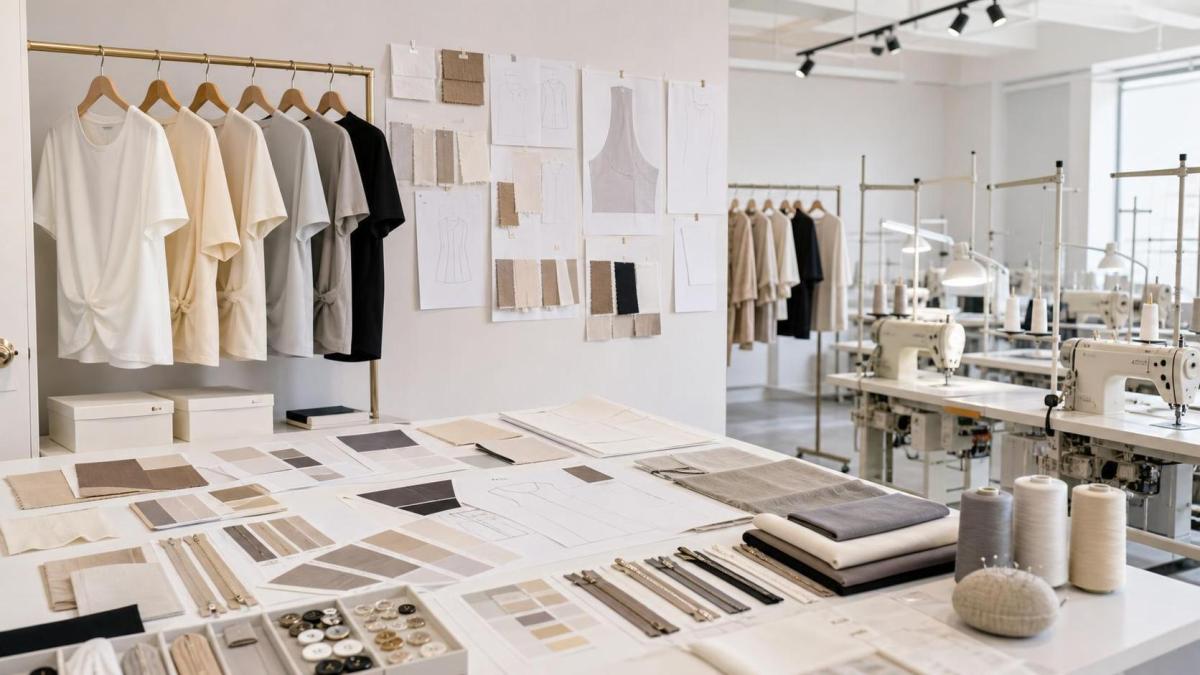
This is where an integrated production base can make a real difference. Shenzhen Meiwuzhi Garment Co., Ltd., for example, combines its own factory capabilities in design, pattern making, accessory production, knitting processing, and bulk garment production. Its factory is located in Changping Town, Dongguan, and it also works with more than ten partner factories across Dongguan, Zhongshan, and Suzhou in Guangdong, as well as Suzhou in Jiangsu. For a small brand, that kind of structure can be useful because it suggests multiple production resources without separating development from execution entirely.
Custom does not mean slow if the product architecture is simple enough
One mistake small brands make is assuming every limited collection piece has to be highly complicated. Often, the fastest launches come from styles with clear brand expression but manageable construction. A well-developed tee, blouse, knit top, or easy dress can move much faster than a heavily engineered fashion piece, especially when the goal is to validate demand.
A good example of this logic is a style built around texture, silhouette, and subtle visual identity rather than excessive complexity. A piece like ZT5181 LV* 26Ss fits that kind of thinking: a short-sleeve tee in draping fabric, with a crew neck, loose silhouette, and a light gold gradient finish. The circular emblem detail gives it a retro-luxury feel, while the overall shape stays commercially wearable. For brands testing a limited release, designs in this category are often easier to sample, easier to style with jeans or blazers, and easier to position as wardrobe staples rather than one-season novelties.
That matters because speed is not only about production lead time. It is also about how quickly a product can be approved internally, merchandised, and understood by the customer.
What decision-makers should evaluate before choosing a partner
The most useful question is not “Can this supplier make custom women's clothing?” Nearly every supplier will say yes. The better question is whether their workflow supports limited-collection realities.
A few indicators are worth checking closely:
- Whether sampling, pattern revision, and bulk production are coordinated by one team or scattered across separate contacts.
- Whether the supplier has experience with both stock-based efficiency and custom development flexibility.
- How they handle low-volume runs, size sets, color variation, and replenishment if one style performs better than expected.
- Whether fabric behavior and fit issues are discussed early, especially for draping materials and looser silhouettes where shape control matters.
- How visible their sell-through feedback loop is, if they also serve retailers or wholesale channels.
That last point is often overlooked. A supplier with exposure to retail movement may not replace your brand's market judgment, but it can sometimes help identify which styles are easier to commercialize and which details create unnecessary delay.
Meiwuzhi’s broader operating structure is relevant here. Beyond manufacturing, it wholly owns Shenzhen taochulai Network Co., Ltd. and Shenzhen Taoshangpin Network Co., Ltd., while the Tchu showroom in Nanshan, Shenzhen is used to display the latest styles and in-stock items. Over 12 years on Alibaba, Taolaichu has reportedly generated sales exceeding 350 million yuan, with more than 130 cooperative physical stores nationwide and over 45,000 online cooperative WeChat business partners and online store clients. Those figures do not automatically guarantee fit for every project, but they do suggest familiarity with how apparel moves across both offline and online channels.
Where custom development saves time later, not just earlier
The obvious gain is a faster first launch. The less obvious gain is that custom development builds reusable assets. Once a brand has approved blocks, grading logic, neckline standards, trim direction, and preferred fabric hand feel, the next collection usually moves faster. Over time, the supplier is no longer starting from zero.
This is particularly valuable in women's apparel because repeatable fit is part of brand trust. If every drop fits differently, small brands lose momentum. If the development partner can maintain consistency across limited runs while still adjusting fashion details, the brand gets both speed and continuity.
That is one reason many growing labels prefer to begin with a narrower range and deepen a few silhouettes. A loose short-sleeve top, for instance, can be reworked across colors, finishes, graphic placements, and fabric weights more easily than a highly structured item. Done well, it becomes a platform for fast seasonal capsules rather than a one-off style.
Common risks that still need attention
Even with a capable supplier, custom production is not automatic. Decision-makers should still watch for a few friction points.
One is over-designing the first run. If the collection carries too many fabric stories, too many trim types, or too many fit categories, development slows down. Another is unclear approval authority. When design, merchandising, and sourcing all give separate comments at different times, sample rounds multiply.
Lead time assumptions can also become unrealistic. “Fast” in apparel never means skipping fit checks or fabric validation. It means compressing avoidable delays while protecting the essentials. Exact timelines usually need to be confirmed against style complexity, fabric readiness, size range, and quantity.
Finally, small brands should ask how replenishment works. A limited collection that sells quickly can create a second problem if the supplier cannot repeat the style in the same hand feel, shade, or construction. That is not always a deal-breaker, but it should be clarified upfront.
A practical way to move faster
For small brands, the value of custom women's clothing is not just uniqueness. It is operational precision. The right partner helps translate ideas into fewer sample rounds, cleaner fit decisions, and more realistic low-volume production. That is what allows limited collections to launch while they still feel current.
If you are planning the next capsule, it is worth reviewing your process in a blunt way: which styles truly need custom development, which ones can be built from proven blocks, what your acceptable first-order quantity is, and where approvals usually get stuck. Once those points are clear, conversations with manufacturers become more useful.
In many cases, the fastest route is not the cheapest quote or the largest factory. It is the supplier whose design, pattern, material, and production decisions are connected closely enough to keep a small collection moving without losing the character that made it worth launching in the first place.

What Is Women's Ready-to-Wear, and How Does It Differ From Made-to-Measure?
Explore women's ready-to-wear vs. made-to-measure: compare fit, quality, cost, and timing to find the right option for your wardrobe. Discover what to check before buying.
Full Package Garment Production: What's Included and Which Costs Are Extra?
Full package garment production: discover what’s included, which costs are extra, and how to compare supplier quotes to avoid hidden fees and protect your womenswear margins.
Fashion Accessories Production: From Approved Samples to Consistent Bulk Quality
Improve fashion accessories production with proven sample, material, and inspection controls. Discover practical ways to reduce defects and deliver consistent bulk quality.


{item.title}
{item.description}
Please give us a message
Contact Us