
Private Label Knitwear Quality Control: Tests to Set Before Production Starts
Private label knitwear quality failures are rarely caused by a single missed inspection at final packing. They usually begin earlier, when a development sample is approved for appearance but the fiber, yarn, dyeing, finishing, construction, care method, and regulatory requirements have not yet been converted into measurable release criteria.
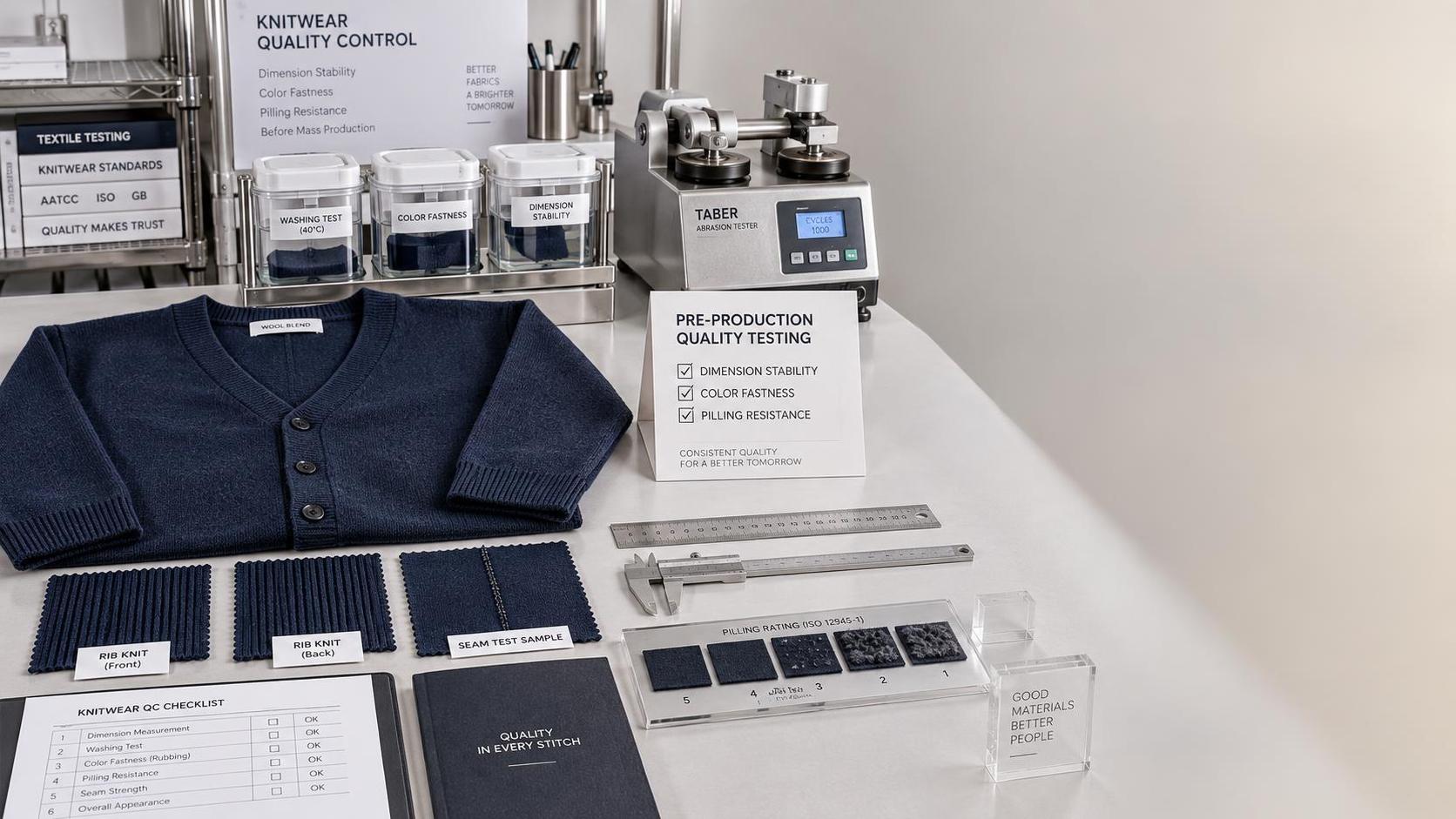
For knitwear, this gap is particularly costly. A sweater can look correct on the sample form yet shrink beyond the intended size after washing, pill at high-friction areas, bleed onto adjacent garments, twist after laundering, or lose seam integrity during wear. Pre-production testing should therefore be treated as a gate for material and process approval, not as a documentation exercise performed after bulk fabric has already been committed.
The correct test plan depends on the product’s fiber blend, gauge, stitch structure, dyeing method, intended customer, care label, destination market, and end use. There is no single universal pass/fail package for all private label knitwear. What matters is that the brand’s specifications identify the applicable method, sample preparation, acceptance limit, and decision owner before yarn ordering or bulk knitting begins.
Start with a testable product specification
A usable quality specification does more than state “soft handfeel,” “good colorfastness,” or “minimal shrinkage.” Those descriptions may be commercially meaningful, but they are not laboratory criteria. The specification needs to connect each requirement to a defined test method and an acceptance rule.
For example, a brushed wool-blend cardigan, a compact viscose rib top, and a cotton-acrylic intarsia pullover should not automatically share the same requirements. Their risks differ. Brushed surfaces are more exposed to fiber shedding and surface change; cellulosic yarns can present wet-growth or dimensional instability issues; rib structures recover differently from plain jersey; intarsia and fully fashioned panels introduce localized tension and seam-related risks.
Before testing begins, the technical file should lock down at least the following:
- Approved fiber composition, including tolerance policy and whether decorative components are included or excluded from labeling calculations.
- Yarn count or specification, yarn-dyed versus piece-dyed status, and color approval reference.
- Gauge, stitch construction, panel measurements, trim construction, and linking or sewing method.
- Required care regime: machine wash, hand wash, dry clean, flat dry, tumble dry, or another stated method.
- Destination-market compliance obligations and whether the item is adultwear, childrenswear, sleepwear, or subject to a special end-use rule.
- Approved test methods, laboratory requirements, sample quantity, retest conditions, and escalation process for failures.
Care instructions require particular discipline. Dimensional-change and appearance testing must reflect the care label the consumer will receive. Testing a garment under a gentle laboratory wash cycle while labeling it for normal machine washing creates an avoidable mismatch. Conversely, a restrictive care label should not be used merely to compensate for an unstable product unless it is genuinely appropriate for the product category and brand promise.
Fiber content verification must precede label approval
Fiber content is both a product-performance issue and a labeling issue. A blend described as wool, cashmere, cotton, viscose, polyester, nylon, or elastane may perform very differently when actual composition deviates from the approved yarn specification. Incorrect composition can also affect washing behavior, pilling, colorfastness, chemical compliance assessment, duty classification, and marketing claims.
Quantitative fiber analysis is commonly conducted using ISO 1833 series methods, which include chemical analysis procedures for textile fibers. The appropriate part of the series depends on the fibers present. For blends containing fibers that are difficult to separate by conventional dissolution methods, an accredited laboratory should select an appropriate method and explain any limitations. Microscopic examination may support fiber identification, but it is not a substitute for quantitative analysis when a declared percentage must be verified.
The test sample must represent the commercial garment. That means considering contrast collars, cuffs, plackets, embroidery yarns, metallic effects, coated yarns, lining, and detachable accessories. Labeling rules can differ by market on whether non-textile parts, minor components, or separate sections are excluded from the declared composition. The label should be reviewed against the applicable local requirement rather than copied from a previous style.
For private label knitwear, fiber testing should be repeated when any of the following changes: yarn supplier, yarn lot strategy, blend ratio, spinning system, color effect yarn, plating yarn, trim material, or approved substitute. A visually similar substitute may not be compositionally or chemically equivalent.
Dimensional stability is not just a shrinkage number
“Shrinkage” is often used as a general term, but knitwear dimensional control is broader. The garment may change in length, chest width, sleeve length, collar opening, or hem width. It may also spiral, skew, stretch out, contract unevenly, or recover poorly after washing. A result that appears acceptable when only body length is measured can still produce an unwearable garment if sleeve length or crosswise width changes excessively.
ISO 5077 provides a framework for determining dimensional change in washing and drying, while ISO 6330 specifies domestic washing and drying procedures used in many test programs. AATCC methods may be used where they are contractually required or appropriate for the market. The critical point is consistency: the wash procedure, detergent condition, drying method, number of cycles, measurement points, and conditioning requirements must be stated in the quality agreement.
Flat drying, line drying, tumble drying, and dry cleaning can produce materially different results. Knitwear intended to be dried flat should be assessed in that condition. Where a product is expected to encounter repeated home laundering, a single-cycle result may not reveal the full risk of progressive growth, relaxation, or loss of recovery. The required cycle count should be tied to the brand standard and intended service conditions rather than selected after a result is known.
Measure actual pattern-critical points, not merely a generic length and width. For a fitted rib knit, recovery at the chest, waist, cuff, and neckline may be more important than overall dimensional change. For a cardigan, front edge length, placket stability, button placement, and panel symmetry may need separate checks. Any acceptance limit should account for the approved measurement tolerance; otherwise a technically “passing” fabric result can still create bulk garments outside the size specification.
Colorfastness must reflect contact, care, and color depth
Colorfastness failures have several forms: staining of adjacent textiles during washing, rubbing transfer onto other garments or upholstery, perspiration-related bleeding, fading under light exposure, and color change caused by dry cleaning or household laundering. A dark, saturated knit may pass a visual shade approval while remaining unsuitable for use with light-colored layers if wet crocking or wash staining is weak.
Commonly used methods include ISO 105 series tests and AATCC equivalents. ISO 105-C06 is frequently used for colorfastness to domestic and commercial laundering; ISO 105-X12 addresses colorfastness to rubbing; ISO 105-E04 addresses perspiration; and ISO 105-B02 addresses colorfastness to artificial light under specified conditions. The selected method, assessment procedure, and rating scale should be stated explicitly because different test conditions are not interchangeable.
Wet rubbing deserves special attention for dark shades, pigment effects, garment-dyed styles, and yarns with surface color application. Dry rubbing alone is not enough to assess transfer risk. Similarly, testing only the main body yarn can miss contrast-color bleeding from stripes, jacquards, embroidery, tipping, or attached trims.
Colorfastness criteria should distinguish between color change and staining. A garment may retain its own shade reasonably well yet stain the multifiber adjacent fabric. Both outcomes matter, but they indicate different corrective actions: dye fixation, washing-off, dye class selection, finishing chemistry, or colorway redesign.
Pilling and surface appearance need realistic interpretation
Pilling is one of the most frequent sources of consumer dissatisfaction in knitwear, but a pilling grade cannot be interpreted without the test method and fabric context. Results from a random tumble pilling method, a Martindale abrasion-based method, and a pilling box method are not directly comparable. Laboratories may use ISO 12945 series methods or ASTM and AATCC alternatives, depending on the agreed protocol.
The method should be selected according to the product’s construction and anticipated abrasion. A lightweight cashmere blend, a brushed acrylic sweater, a dense merino jersey, and a boucle knit may all develop surface change differently. A strict requirement may be technically unrealistic for a deliberately hairy or brushed surface, while a relaxed criterion for a smooth, close-knit garment may create avoidable brand risk.
Assessment should examine more than pills. Fiber loss, fuzz formation, snagging, abrasion marks, yarn breakage, and changes in luster can affect perceived quality even if the pilling grade is technically within the approved range. If the product has a special finish, test both before and after laundering because some anti-pilling finishes can change after wash exposure.
Where retail handling is expected to be intensive, abrasion and snag resistance may need separate evaluation. A pilling test does not automatically establish snag resistance, and neither result replaces visual examination of loose floats, exposed yarns, or fragile decorative constructions.
Seam, linking, and attachment strength should be tested at the garment level
Knitted panels do not fail in the same way as woven seams. Fully fashioned linking, overlock seams, coverstitch operations, shoulder tapes, neck bindings, button plackets, and decorative attachments each have distinct failure modes. A strong yarn does not guarantee a durable assembled garment.
For seamed garments, seam strength and seam slippage assessment may be relevant, although test selection must suit the construction. ISO 13935 series methods address seam tensile properties for sewn seams, but knitwear often requires garment-specific evaluation as well. Pull testing can identify weak button attachment, poorly secured labels, unstable decorative hardware, or insufficiently reinforced shoulder seams. Stretch and recovery testing may be necessary at cuffs, neck openings, waistbands, and rib hems where loss of elasticity affects fit.
Testing should focus on the actual stress points created by wear. Cardigan front edges can distort under button loading. Heavy sweaters can extend at shoulder seams when hung. Fine-gauge knits may split at armhole joins if linking tension is inconsistent. A laboratory result should be supported by a controlled wear-simulation or manual extension assessment when the construction presents a known practical vulnerability.
Restricted substances require a destination-specific control plan
Chemical compliance cannot be managed through a general statement that all materials are “eco-friendly” or “non-toxic.” The applicable substances, limits, reporting obligations, and testing approach depend on the market, product category, fiber and trim composition, and chemical processes used.
For goods placed on the European Union market, REACH restrictions, including relevant entries in Annex XVII, may apply to textile articles. Requirements concerning substances of very high concern can also create information obligations in defined circumstances. Persistent organic pollutant restrictions may be relevant to certain chemical treatments or materials. In the United States, children’s products can be subject to specific requirements under the Consumer Product Safety Improvement Act, including limits for lead and phthalates in applicable products and components. California Proposition 65 is a separate warning-law framework and should not be confused with a product certification system.
A restricted substances list should therefore identify the destination markets and cover relevant risk groups, such as azo colorants capable of releasing restricted aromatic amines, formaldehyde, extractable heavy metals, phthalates in prints or soft plastic components, organotin compounds, dimethyl fumarate, chlorinated phenols, certain flame-retardant chemicals where relevant, and per- and polyfluoroalkyl substances where water- or stain-repellent finishes are used. The exact list and limits should follow the brand’s current compliance program and applicable law.
Test planning should be risk-based, not random. A plain undyed cotton knit has a different chemical profile from a black pigment-printed top, a coated metallic yarn sweater, or a garment with polyurethane badges, plastic buttons, silicone prints, and water-repellent finishing. Supplier declarations, chemical inventories, transaction certificates where applicable, and test reports should be reviewed together. A passing bulk-garment test does not validate an undocumented chemical-management system, especially when suppliers change dyes, finishes, prints, or component sources.
Voluntary schemes such as OEKO-TEX STANDARD 100 may support material sourcing and chemical control, but certification scope, certificate validity, product class, and covered components must be checked. A certificate for one yarn or fabric does not automatically cover every trim and processing stage in the finished garment.
Set the approval sequence before bulk commitments are irreversible
The most effective pre-production control is a release sequence that prevents bulk production from moving ahead on unresolved risks. The sequence should begin with yarn and trim approval, then fabric or panel testing where relevant, followed by a finished-garment pre-production sample tested under the agreed protocol. Bulk production should use only the approved material sources, dyeing route, finishing recipe, and construction method.
Where testing is outsourced, laboratories operating to ISO/IEC 17025 provide an additional level of confidence that the stated methods are within an accredited quality system. Accreditation does not make every result automatically suitable; the report must still show the correct sample description, method version, conditioning, deviations, result units, and assessment basis.
When a result fails, the response should not be limited to retesting a replacement specimen. The decision record needs to identify whether the failure arose from sample variation, test preparation, material quality, processing conditions, construction, or an unrealistic requirement. Rework may involve changing yarn twist, blend ratio, knit density, dye fixation, softener selection, finishing, sewing settings, reinforcement, or care instructions. Any corrective action that changes the product should trigger a targeted revalidation rather than an assumption that the prior result remains applicable.
Private label knitwear quality control becomes reliable when laboratory testing, technical specifications, compliance documentation, and production controls describe the same product. That alignment is what prevents a sample approval from becoming a bulk-production liability.
Previous:No more content
Next:No more content

Private Label Knitwear Quality Control: Tests to Set Before Production Starts
Private label knitwear quality control guide: set pre-production tests for fiber content, shrinkage, colorfastness, pilling, seams, and compliance.
Do women's clothing OEM factories provide design development support for new collections?
Do women's clothing OEM factories offer design support for new collections? Discover how top-tier partners like Meiwuzhi integrate design into production—speeding up development, improving fit, and reducing revisions.
Do High-End Women’s Apparel Factories Accept Custom Pattern Making
Do high-end women's apparel factories accept custom pattern making? Yes—when fabric, fit, and sampling align. Learn what premium factories require and how to improve development success.



{item.title}
{item.description}
Please give us a message
Contact Us