
How to Plan a Seasonal High-End Women's Apparel Collection
A strong seasonal collection begins with a commercial choice: decide which customers and occasions the range must serve, then build a manageable assortment around them. For a high-end women’s apparel business, the best plan balances a distinctive point of view with enough continuity in fit, quality, and pricing to make the collection recognizable and commercially viable.
That balance will differ by business. A retailer buying for established clients may need proven silhouettes in refreshed fabrics, while a newer brand may depend on a smaller number of distinctive pieces to establish its identity. In both cases, high-end women's apparel seasonal collection planning works best when design, margin, inventory, and production decisions are made together, before a large range of samples is commissioned.
Start With the Customer’s Season, Not the Trend Board
Define the collection around the customer’s actual wardrobe needs. A season can include office dressing, travel, events, and transitional weather, but a single collection does not have to address every occasion. Choose the settings where the business has the strongest reason to compete, then decide how formal, versatile, and fashion-led the range should be.
Existing sales can help identify what customers buy repeatedly, where they hesitate, and which price points require more explanation. Review returns and alterations alongside sell-through: a jacket may sell well but generate consistent complaints about sleeve fit, while a slower-selling dress may perform better in stores where customers can try it on. For a new business without sales history, customer interviews, competitor store visits, and a small initial assortment can provide useful direction, though they are not substitutes for actual sell-through.
Separate information about what customers admire from evidence of what they will buy. A striking runway-inspired silhouette may attract attention online, yet a boutique serving clients who prioritize ease of wear may need that idea translated into a more practical shape. Trend research is most useful when it helps edit choices in color, proportion, or detail against a defined customer and price position.
Write a brief that can guide both creative and commercial decisions. It should identify the target customer, selling channels, main wearing occasions, intended delivery window, price architecture, and the qualities that should make the range feel premium. If the brief describes several unrelated customers or requires every style to serve every occasion, narrow it before moving into development.
Build an Assortment, Not a Set of Individual Looks
A collection can contain attractive garments and still fail as a range. Styles may compete for the same purchase, leave gaps in important categories, or require separate fabrics and trims that make production difficult. An assortment plan gives each proposed style a role before design details become expensive to change.
For a multi-brand retailer, the comparison is often between continuity and novelty: how much of the budget should support dependable categories, and how much can be allocated to fashion-led pieces? For a brand developing its own line, the same question extends to patterns, fabric commitments, and production capacity. A practical starting point is to group styles by function:
- Core pieces: Familiar shapes or categories expected to carry the range, such as tailored trousers, refined knitwear, or a signature jacket.
- Seasonal updates: Established silhouettes changed through fabric, color, proportion, or restrained detailing.
- Statement pieces: More distinctive designs that express the season’s point of view and may be bought in smaller quantities.
These groups do not need a fixed percentage. The right mix depends on selling history, cash available for inventory, and how much fashion risk the customer expects. A business with a strong replenishment program may put more weight behind core styles; a boutique known for occasionwear may need a greater proportion of statement pieces. The important step is to assign each style a purpose and a planned quantity, rather than treating every design as equally important.
Map the range by category, price, color, and delivery date. Look for duplication: three black tailored jackets at similar prices need a clear distinction in fit, fabric, or customer use. Also look for missing connections. If several tops have no coordinating bottom, or an outerwear story arrives after the weather has changed, the collection may be harder to sell as a wardrobe.
Color cohesion helps customers combine pieces, but it should not force every garment into the same palette. A few coordinated colors can support merchandising across categories, while an accent color or print gives the season a recognizable identity. Before approving a broad palette, check whether the chosen fabrics can deliver the desired shades consistently and whether minimum orders are practical.
Compare Fabrics and Construction Against the Price
Fabric is one of the most visible signals of quality, but fiber content alone does not establish whether a garment feels premium. Weight, drape, opacity, recovery, surface finish, and behavior after care all affect the customer’s experience. A fabric that feels luxurious on a hanger may perform poorly in a fitted trouser, while a less delicate alternative may give the intended silhouette a longer useful life.
Compare fabrics in the context of the finished garment. For a structured jacket, examine whether the material supports the desired shape without excessive stiffness. For a fluid dress, assess how it moves, whether it needs lining, and how it behaves at seams. For knitwear, consider hand feel and shape retention alongside the design. Request the available fabric specifications and agree on appropriate checks for the intended use before committing to bulk yardage.
Construction choices should support the same positioning. Lining, interfacing, seam finishes, button quality, and pattern matching can all affect appearance and durability, but each adds cost or production complexity. A fully lined garment is not automatically better for every climate or silhouette; a lighter finish may be more suitable if it is executed cleanly and gives the customer the intended comfort.
Compare options at the garment level, not just by fabric price per unit. A lower-priced cloth may require more lining, additional reinforcement, or a more complicated cutting layout. Conversely, a more expensive material can be difficult to justify if the customer cannot see or feel the difference at the intended retail price. Ask for costings that separate the main fabric, trims, construction, and other relevant charges so the trade-offs are visible.
Allow for care requirements when deciding whether a material fits the customer’s life. A delicate fabric may be appropriate for an occasion piece but less persuasive in a frequently worn travel wardrobe. Care instructions should reflect the finished garment and its components, not the shell fabric alone.
Set the Price Architecture Before Finalizing the Range
Start with the intended selling price and work backward to an acceptable landed cost and margin. Include the costs relevant to the business, which may extend beyond garment production to freight, duties where applicable, packaging, quality inspection, and the expected cost of selling through the chosen channel. A wholesale brand also needs enough room for both its own economics and the retailer’s pricing requirements.
A simple comparison can expose a weak design decision early. If two dresses occupy the same price tier, one may offer a more complex construction while the other depends on an expensive fabric. Decide which benefit the customer is more likely to value, then adjust the less convincing option. Avoid lowering quality across the entire garment to rescue a cost target; changing a nonessential detail, reducing fabric consumption through a revised pattern, or moving the style to a different price tier may be more coherent.
Prices also need to make sense relative to one another. A customer should be able to understand why a statement coat costs more than a lighter jacket, or why one blouse sits above another. That does not require communicating every production detail, but the differences in material, finish, design, or functionality should be apparent.
Plan quantities with the financial exposure of each style in mind. A highly distinctive piece may warrant a smaller initial commitment than a proven trouser, particularly when the fabric cannot be reused elsewhere. Smaller orders can reduce inventory exposure but may raise unit costs or be unavailable at the desired terms. Compare those costs against the risk of holding excess stock, and establish whether repeat production is feasible before relying on it as a solution.
Use Sampling to Test the Collection as a System
Sampling should resolve more than whether a design looks attractive. A first sample can reveal problems in proportion or construction; subsequent fittings should test the revisions against the intended customer, size range, and fabric. Keep a record of changes and approve a clear reference sample so that design, production, and quality teams are working from the same version.
Fit decisions deserve particular attention in a premium collection. A consistent block can help customers trust sizing across styles, but different silhouettes and fabrics still need their own fit assessment. A woven trouser with limited stretch will behave differently from a knit trouser, even when the measurements appear similar. Review movement, comfort, and garment balance as well as static measurements.
Assess samples together, not only one by one. Place tops with intended bottoms, compare similar colors across fabrics, and check whether the range has enough variety without losing its identity. This is also the point to remove attractive styles that duplicate a stronger piece or do not justify their cost. Editing a collection before bulk production can protect both the budget and the clarity of the final assortment.
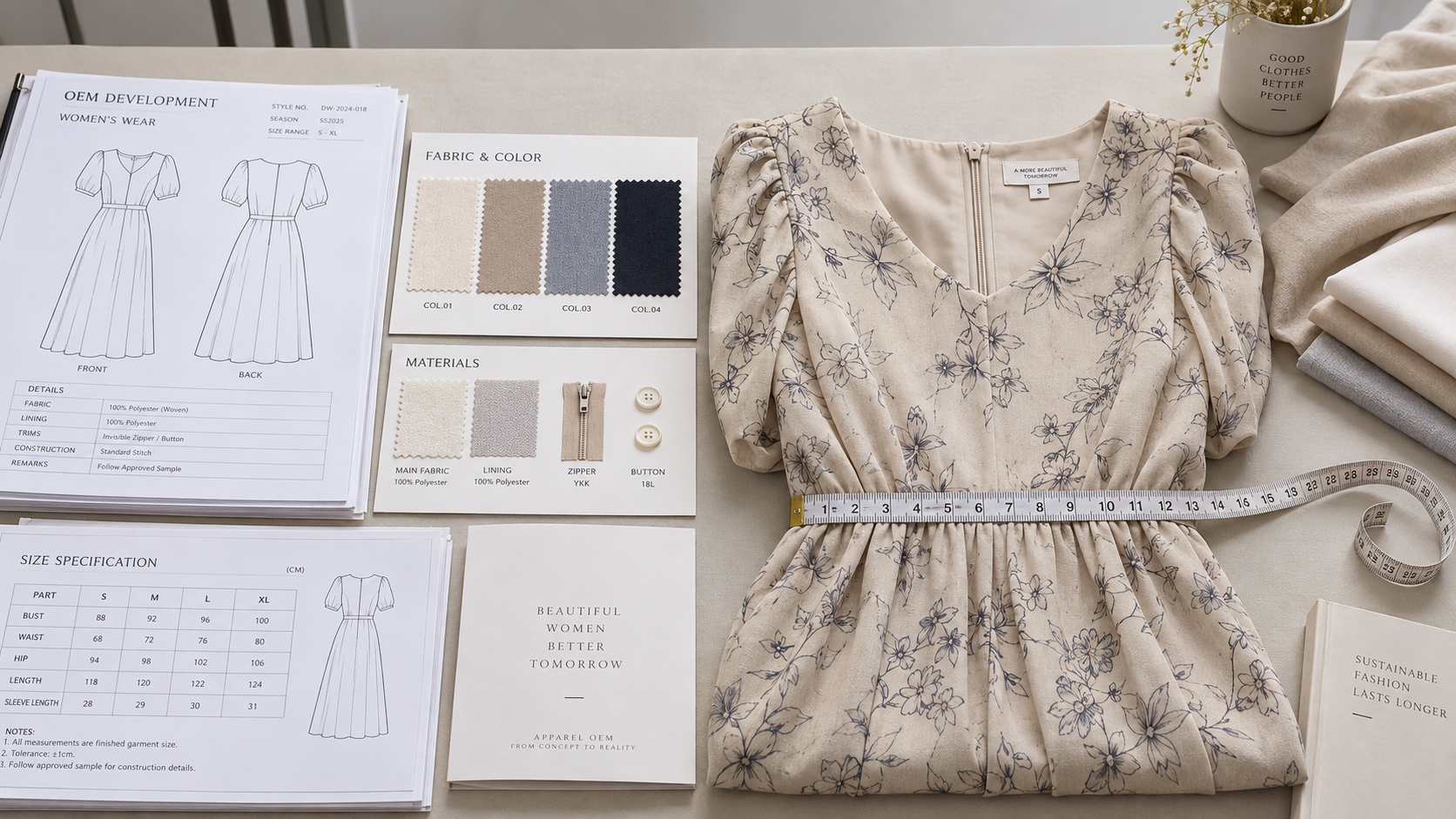
Once a style is approved, document its specifications, including measurements and tolerances, construction details, fabric and trim references, labels, and packing requirements. Agree on how changes will be authorized if a material or component becomes unavailable. Substitutions can affect hand feel, appearance, fit, or care, so a visually similar replacement should not be treated as automatically equivalent.
Work Backward From Delivery and Keep Room for Decisions
Set the required arrival date for each channel, then work backward through production, material sourcing, sampling, approvals, inspection, and transport. The calendar should reflect actual supplier commitments and the time needed for corrections, not just an ideal sequence in which every sample is approved immediately. A fabric with a long lead time may need a decision before the rest of the collection is complete.
Separate delivery into meaningful groups where the assortment supports it. Transitional pieces may need to arrive earlier than heavier garments, while occasionwear should reach the sales floor in time for the events it serves. Staggered delivery can keep the range relevant, but only if related pieces arrive close enough together for customers to buy them as outfits.
Before placing the final order, review each style against three questions: Does it fill a clear role in the assortment? Can it reach the intended quality and price? Can it be produced and delivered when the customer needs it? A design that fails one of those tests may still be worth revising, but it should not remain in the range simply because it has already been sampled.
After launch, track results by style, size, color, and channel where the data is available. Record the reasons behind returns, markdowns, and missed sales as carefully as sales volume. That information will make the next seasonal brief more precise, particularly when deciding which fits to retain, which fabric choices to reconsider, and where the business can afford to take a more deliberate creative risk.

What Happens if Delivered Garments Have Quality Defects?
What happens if bulk garment manufacturing has quality defects after delivery? Learn how to document issues, notify suppliers, and negotiate remedies.
Can Small Buyers Negotiate Designer Women's Clothing Prices?
Are designer women's clothing wholesale prices negotiable for small orders? Discover practical ways to negotiate pricing, minimums, shipping, and better terms.
How to Find a Reliable High-End Women's Apparel Wholesaler
Learn how to find a reliable high-end women's apparel wholesale supplier. Discover how to assess quality, verify factories, compare quotes, and avoid costly sourcing mistakes.

{item.title}
{item.description}
Please give us a message
Contact Us