
Can High-End Women's Apparel Be Made with Sustainable Materials?
Can high-end women's apparel be produced with sustainable materials? Absolutely—and today’s fashion leaders are proving it with refined design, premium fabrics, and responsible manufacturing. For brands and buyers in the apparel industry, sustainability no longer means compromising on elegance, comfort, or craftsmanship. Instead, it opens new opportunities to meet rising consumer expectations while building a more competitive and future-ready women’s fashion business.
The real question for professional buyers and fashion brands is not whether sustainable materials are possible, but whether they can support premium positioning, stable quality, and commercial performance at scale.
The answer is yes, provided the brand chooses the right fabrics, sets realistic product standards, and works with manufacturing partners that understand both luxury construction and responsible sourcing.
What Are Buyers Really Asking When They Search This Question?
When people search can high-end women's apparel be produced with sustainable materials, they are usually looking for commercial proof, not theory. They want to know whether sustainability can work in a serious fashion business.
That means understanding whether sustainable fabrics feel premium, whether they hold color and shape, whether they fit luxury design expectations, and whether production can remain reliable across repeated orders.
For brand founders, sourcing managers, wholesalers, and boutique retailers, the concern is practical. They need apparel that looks elevated, performs well, and supports margins without creating avoidable supply chain risk.
In other words, the search intent is decision-oriented. Readers are evaluating whether sustainable materials can genuinely support high-end women's fashion instead of weakening brand perception or increasing complexity beyond control.
Yes, High-End Women's Apparel Can Be Sustainable Without Looking Basic
One outdated assumption still affects sourcing decisions: that sustainable fashion must look rustic, plain, or less refined. In the premium women's market, that idea is no longer accurate.
Modern sustainable materials can deliver softness, drape, structure, sheen, and tactile richness. With the right fabric development and garment engineering, they can absolutely meet the visual and sensory standards of high-end apparel.
Luxury in women's fashion is not created by fabric claims alone. It comes from silhouette precision, pattern balance, finishing quality, trim selection, and consistent garment execution across every production stage.
That is why sustainable high-end apparel succeeds when sustainability is integrated into a strong product system, not treated as a marketing label added after design decisions are already fixed.
Which Sustainable Materials Actually Work for Premium Women's Fashion?
Not every eco-labeled fabric belongs in an upscale collection. Buyers need to distinguish between materials that merely sound responsible and those that can perform well in premium dresses, tops, knitwear, skirts, and tailored pieces.
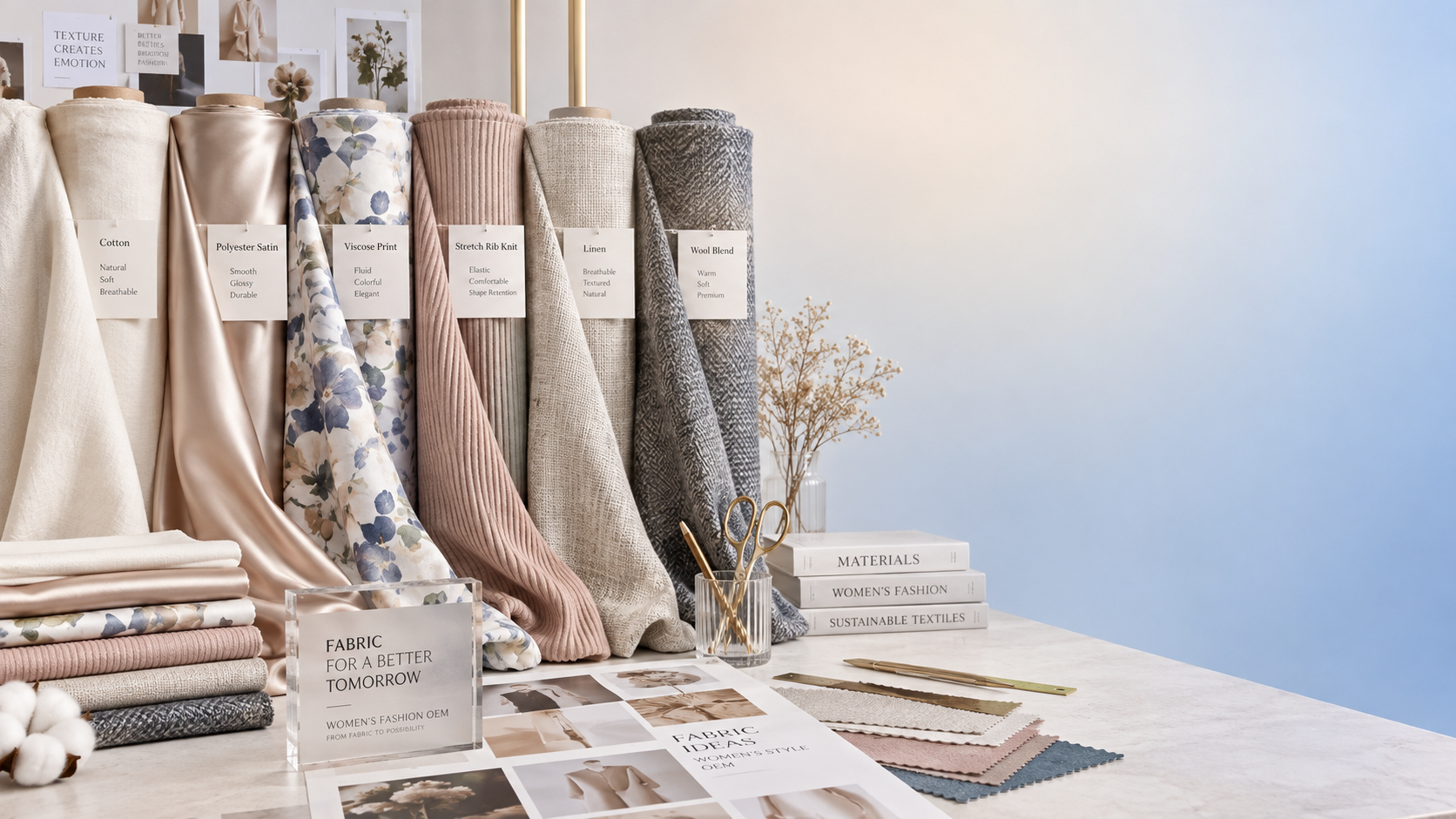
Organic cotton is one of the most accessible options. In high-quality constructions, it offers softness, breathability, and comfort while supporting a cleaner raw material story for elevated casual and contemporary products.
TENCEL Lyocell and modal are especially relevant for high-end women's apparel. They provide fluid drape, a smooth hand feel, and polished surface appearance, making them suitable for blouses, dresses, and soft tailoring.
Eco-viscose from verified sources can also support sophisticated styling when developed carefully. The key is to evaluate yarn quality, fabric density, shrinkage behavior, and finishing consistency before approving bulk production.
Recycled polyester has a place in premium apparel as well, particularly in linings, structured dresses, outerwear, and blends where wrinkle resistance or durability matter. However, hand feel and fabric development remain critical.
Responsible wool, recycled wool blends, and certified cashmere alternatives can support premium knitwear and cold-weather collections. These materials are especially valuable when brands want luxury texture with a stronger sustainability narrative.
Linen, hemp blends, and regenerated cellulosic fabrics can also work beautifully in high-end women's lines, especially when the design language embraces natural texture, breathable comfort, and understated sophistication.
What Makes a Sustainable Fabric Feel Truly High-End?
Premium positioning depends less on buzzwords and more on fabric behavior. The most important factors are drape, resilience, surface refinement, touch, opacity, color response, and how the material supports garment structure.
A sustainable material may be responsibly sourced, but if it pills quickly, wrinkles excessively, feels harsh, or loses shape after cleaning, it will not support a high-end market position.
Luxury buyers notice small things. They notice whether a dress hangs cleanly, whether a blouse moves elegantly, whether seams remain smooth, and whether the fabric feels substantial rather than flimsy.
This is why sampling and testing matter more than generic sustainability promises. Fabric selection for premium women's apparel must balance environmental goals with comfort, aesthetics, and repeatable quality standards.
Can Sustainable Apparel Still Deliver the Craftsmanship Expected in Luxury?
Yes, but craftsmanship does not happen automatically just because the fabric is expensive or responsibly sourced. High-end results depend on pattern development, cutting accuracy, sewing control, and finishing discipline.
Sustainable materials sometimes require different handling during production. Certain fabrics may shift more during cutting, respond differently to heat, or need special tension settings during stitching and pressing.
Manufacturers with real experience in premium women's apparel understand these variables. They know how to protect drape, control distortion, manage seam quality, and preserve the intended silhouette from sample to bulk order.
That technical capability is often the dividing line between a product that simply uses sustainable materials and a product that truly belongs in the high-end women's fashion segment.
How Should Brands Evaluate a Sustainable Apparel Supplier?
For most buyers, the key decision is not only which fabric to use, but which manufacturing partner can translate that fabric into commercially viable premium apparel with consistency and speed.
Start by reviewing product development capability. Can the supplier support design, pattern making, trims, knitting, sampling, and bulk production in a coordinated way rather than through disconnected outsourcing?
Next, examine fabric understanding. A capable supplier should explain which sustainable materials fit different categories, what risks exist, and how construction choices affect quality, cost, and garment performance.
Ask how they manage production stability across multiple styles and repeat orders. Premium customers expect consistency in fit, color, finishing, and detail, especially when collections are distributed across many retail channels.
It is also important to review response speed and communication quality. Sustainable sourcing often involves approvals, substitutions, and fabric discussions that require a partner who can solve problems early.
Companies with integrated development and manufacturing systems are often better positioned to support this process. That is particularly valuable for brands that need both high-end presentation and dependable operational execution.
What Business Value Does Sustainable High-End Women's Apparel Create?
Sustainability matters because it can strengthen market position, not simply because it sounds responsible. In women's fashion, it increasingly influences brand trust, product differentiation, and long-term customer loyalty.
Consumers in the premium segment are paying closer attention to material choices, production ethics, and product lifespan. They want clothing that reflects taste and quality, but also better values and fewer compromises.
For retailers and wholesalers, sustainable premium apparel can create stronger storytelling at the point of sale. It gives sales teams a clearer reason why a garment deserves attention beyond style alone.
For brands, it also supports future readiness. Regulations, sourcing expectations, and platform standards are all evolving. Building a sustainable product strategy now reduces pressure later and improves adaptability.
Most importantly, sustainable high-end apparel can improve perceived value when done well. Customers are more likely to recognize a product as thoughtful, modern, and worth investing in.
What Concerns Usually Stop Buyers From Moving Forward?
The most common concerns are price, fabric stability, inconsistent supply, uncertain certification, and fear that sustainability claims may not translate into actual customer demand or better sell-through.
These concerns are valid. Sustainable materials can cost more in some categories, and not every supplier has the expertise to maintain premium standards during development and bulk production.
However, the right response is not to avoid sustainable materials entirely. It is to evaluate them through a clear sourcing framework that includes touch, appearance, wash behavior, fit retention, lead time, and reorder reliability.
Buyers should also avoid treating sustainability as an all-or-nothing decision. A collection can begin with selected core fabrics or categories where responsible materials already perform very well.
This staged approach lowers risk while giving the brand real market feedback. It also allows the team to build supplier knowledge and internal confidence before scaling a broader sustainable product program.
How Can Brands Introduce Sustainable Materials Without Disrupting Their Collection?
The most effective approach is to begin with categories where fabric performance and premium perception are already well aligned. Dresses, blouses, knit tops, and soft separates are often strong entry points.
Choose materials with proven drape, comfort, and finishing quality rather than experimental options that may complicate production. This helps protect the brand image while making sustainability visible in a credible way.
Keep design language consistent with the brand's established identity. Customers should experience the garment as elegant and desirable first, with sustainability serving as an added value rather than the only selling point.
Sampling should include wear testing, wash testing, and fit review. For premium women's apparel, small differences in hand feel, recovery, seam behavior, and trim compatibility can affect final market performance.
From there, brands can expand gradually into additional fabric families and product groups, guided by customer response, replenishment patterns, and margin performance.
Why Manufacturing Depth Matters in Sustainable Premium Fashion
High-end women's apparel requires more than access to fabrics. It requires development depth, technical coordination, and production experience across design, pattern making, trimming, knitting, and garment assembly.
Manufacturers with broad operational capability can help brands shorten development cycles while keeping quality under control. That becomes especially important when working with new sustainable materials or refined fashion silhouettes.
Shenzhen Meiwuzhi Garment Co., Ltd. operates within this kind of integrated apparel environment, combining its own factory capabilities with coordinated production resources across multiple manufacturing locations.
Its structure supports design development, pattern making, accessory production, knitting processing, and bulk garment manufacturing, which are all critical when producing premium women's apparel that must meet both visual and technical expectations.
For buyers and fashion businesses, this kind of system matters because high-end sustainable apparel depends on execution. Material selection is only the start; the finished garment is what ultimately defines value.
So, Can High-End Women's Apparel Be Produced With Sustainable Materials?
Yes, and for many fashion businesses, it should be. Sustainable materials are already capable of supporting premium women's apparel when they are matched with strong design judgment and technically reliable manufacturing.
The brands that benefit most are those that evaluate sustainability through a business lens: fabric performance, customer perception, product consistency, sourcing transparency, and long-term brand positioning.
High-end fashion and sustainability are no longer competing goals. In a well-managed product strategy, they strengthen each other by combining quality, responsibility, and modern market relevance.
For buyers, wholesalers, retailers, and brand owners, the better question now is not whether sustainable materials can work. It is which materials, partners, and product categories will help them work best.
That is where informed sourcing decisions create real advantage. When sustainable materials are chosen carefully and produced with premium standards, they can absolutely deliver the elegance, craftsmanship, and commercial value expected in high-end women's apparel.
Previous:No more content
Next:No more content

What Fabrics Are Commonly Used in Women’s Clothing OEM Production?
What fabrics are commonly used in women's clothing OEM production? Explore cotton, polyester, viscose, knits, and blends for better fit, quality, and value.

Why women's knitwear orders get delayed
Learn why women's knitwear orders are delayed by yarn shortages, sampling revisions, and Chinese New Year congestion. Use seven production checkpoints, early yarn reservations, dual sourcing, and progress checks to protect delivery timelines.
What makes high-end women's fashion bags resistant to seasonal material degradation?
Discover how high-end women's fashion bags resist seasonal degradation—material science, vertical integration & real-world validation revealed.


{item.title}
{item.description}
Please give us a message
Contact Us