
Can High-End Women’s Apparel Be Made with Sustainable Materials
Can high-end women’s apparel be produced with sustainable materials? Yes—but the honest answer is that it depends on what you mean by “high-end,” what level of sustainability you expect, and how disciplined the supply chain is from fabric selection to final pressing.
In premium womenswear, customers do not forgive rough handfeel, unstable color, poor drape, or garments that lose shape after a few wears. That is where the conversation gets real. Sustainable materials are no longer limited to rough organic cotton basics or niche eco capsules. Today, a well-developed collection can use recycled fibers, responsibly sourced cellulosics, lower-impact knits, and better trims while still delivering the polish expected in boutique retail and contemporary fashion channels.
The challenge is not whether sustainable materials exist. It is whether they can be turned into premium garments without losing silhouette, touch, consistency, or commercial viability.
Luxury Look, Sustainable Base: Where It Works Best
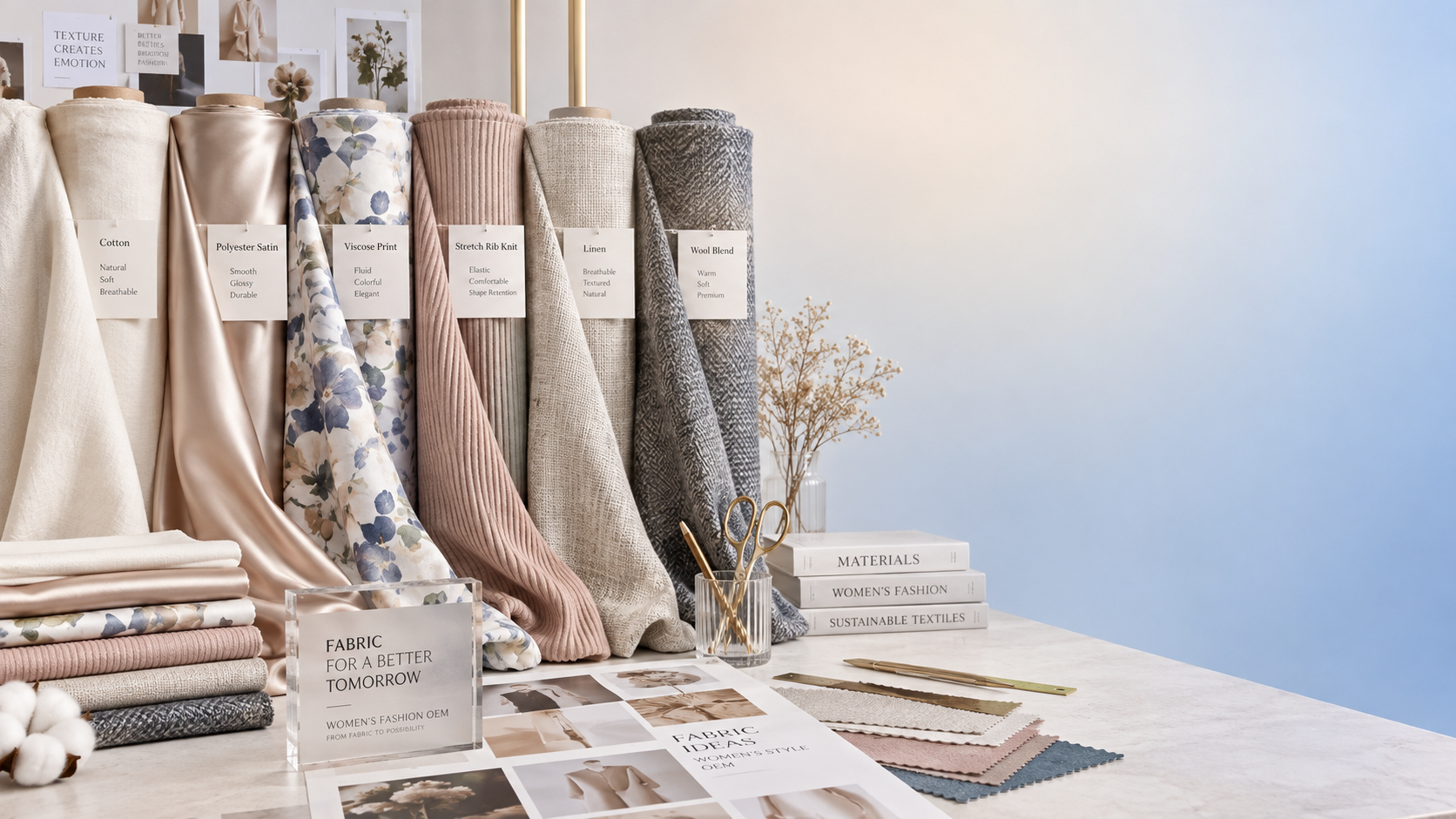
Some categories adapt to sustainable materials more naturally than others. Soft tailoring, knit dresses, blouses, skirts, and refined casual sets often make the transition well because they can benefit from materials such as TENCEL™-type cellulosics, certified viscose alternatives, organic cotton blends, recycled polyester linings, or recycled nylon in technical constructions. These fabrics can drape beautifully, take color well, and support modern silhouettes.
The harder categories are the ones where the fabric must do several jobs at once: hold a sculpted shape, resist wrinkling, pass repeated wear, and feel unmistakably premium. A sharply tailored jacket, for example, may need structure, recovery, and a clean surface. In that case, switching blindly to a “green” fabric can backfire. A sustainable option that pills easily or collapses at the lapel will not survive premium positioning.
That is why experienced manufacturers usually start with the end use, not the sustainability claim. Eveningwear needs fluidity. Knitwear needs recovery. Premium blouses need opacity and skin comfort. Once those performance demands are clear, the material shortlist becomes much more realistic.
What “Sustainable” Really Means in High-End Apparel
A lot of confusion comes from treating sustainability as one single feature. In practice, it may refer to fiber origin, water use, dyeing impact, recycled content, durability, biodegradability, or supply chain transparency. High-end brands usually cannot rely on a vague eco story. Buyers increasingly ask more practical questions: Is the fabric traceable? Will the mill provide composition and test details? Are the trims aligned with the same standard, or is only the shell fabric improved?
For women’s premium apparel, sustainability tends to work best when it is approached as a hierarchy of decisions rather than a single label:
- Choose fibers with a lower-impact or recycled route where they still meet design intent.
- Reduce waste in pattern making, marker planning, and sampling.
- Use trims, linings, and packaging that do not undermine the main material choice.
- Build garments to last longer, because durability is part of responsible production too.
That last point matters more than many people admit. A beautifully made dress that keeps its shape for seasons can be a better outcome than a poorly made “eco” dress that is discarded quickly.
Why Premium Brands Still Hesitate
The hesitation usually comes from three places: fabric consistency, price pressure, and development risk.
Fabric consistency is a serious issue in premium collections. Even small shifts in shade, texture, shrinkage, or width can disrupt production, especially when a style is cut across multiple size runs or repeat orders. Sustainable fabrics can be excellent, but they still need mill discipline. Retailers do not care whether a problem came from a recycled yarn lot or a conventional one; they care that sleeves match, seams lie flat, and the rack presentation stays clean.
Price is the second concern. Some lower-impact fabrics and more controlled processing routes cost more upfront. That does not automatically make them too expensive, but it does change the margin conversation. In high-end women’s apparel, this can still make sense if the product story, feel, and fit justify the ticket. It becomes much harder if the garment is trend-driven and expected to move at aggressive speed with little tolerance for fabric testing.
Then there is development risk. A premium garment is not just fabric plus sewing. Pattern balance, fusible compatibility, seam behavior, washing outcome, and trim coordination all affect the result. One material substitution can force a chain reaction through the whole package.
How Good Manufacturers Make It Work
This is where operational depth matters. A company working in high-end women’s apparel needs more than sourcing access; it needs development control. Shenzhen Meiwuzhi Garment Co., Ltd., for example, operates with its own factory in Changping, Dongguan and coordinates with more than ten partner factories across Dongguan, Zhongshan, Suzhou in Guangdong, and Suzhou in Jiangsu. That kind of structure matters because sustainable production is rarely solved by one workshop alone.
When design, pattern making, accessory development, knitting processing, and bulk production can be connected instead of fragmented, teams have a better chance of catching the issues that usually hurt premium results. A sustainable knit may need different tension control. A drapey cellulose blend may require pattern adjustment to prevent neckline distortion. Recycled-based linings may behave differently under pressing. These are not theoretical problems; they show up in sampling rooms every day.
In practice, strong manufacturers tend to do a few things consistently:
- They test fabric behavior before locking the style count.
- They match sustainable material choices to product category instead of forcing them everywhere.
- They review trims and interlinings early, because these hidden components often ruin the result.
- They treat finishing and quality control as part of the sustainability equation, not as a separate factory problem.
That is often the difference between a collection that merely sounds responsible and one that is actually wearable, sellable, and worth repeating.
The Material Question Buyers Should Ask Earlier
Many buyers ask, “Do you have sustainable fabrics?” too late in the process. A better question is, “For this silhouette and target price, which sustainable routes still protect the handfeel, drape, and repeatability we need?” That shifts the discussion from marketing language to product reality.
If you are developing premium women’s apparel, a few checks save time:
This kind of review is especially relevant for brands selling through mixed channels. Meiwuzhi’s network—through its own manufacturing operations, Tchu showroom in Shenzhen, long-term Alibaba presence, over 130 cooperating physical stores, and a large online wholesale base—reflects a reality many apparel businesses face: the same style may need to satisfy both showroom expectations and repeat-order practicality. Sustainable materials only help if they can survive that test.
What Usually Goes Wrong
One common mistake is assuming that a sustainable fabric automatically supports a premium price. It does not. If the silhouette is ordinary, the finishing is weak, or the fit is unresolved, the eco angle will not rescue the garment.
Another mistake is replacing too many components at once. Brands switch shell fabric, lining, care label, packaging, and trim package in one move, then struggle to identify the cause when production becomes unstable. Experienced teams usually phase changes in. That creates a cleaner learning curve.
There is also a quiet but expensive problem: using sustainable fabrics in styles that demand excessive rework. If cutting loss is high, sewing damage increases, or pressing requires repeated handling, the intended environmental gain may narrow. This is why responsible premium production is not just a material decision. It is a pattern, process, and yield decision too.
A Practical Way Forward for Brands and Retailers
If you are introducing sustainable materials into high-end women’s apparel, start with the styles where success is most likely: refined knits, draped dresses, premium blouses, elevated casual sets, and lining upgrades. Build confidence there. Then move into more technical tailoring once your fabric and factory partners prove consistency.
Also, ask for fewer promises and more development clarity. What can the fabric actually do? How does it behave after pressing or washing? Is the mill stable for reorder quantities? What compromises, if any, should be expected in texture or structure? Real partners answer those questions directly.
So, can high-end women’s apparel be made with sustainable materials? Absolutely. But the garments that succeed are rarely the result of a simple material swap. They come from careful sourcing, honest category selection, technical pattern work, and production teams that understand that luxury is felt in the details. If those details are managed well, sustainability does not dilute premium fashion—it sharpens what modern premium fashion is supposed to be.
Previous:No more content
Next:No more content

What Fabrics Are Commonly Used in Women’s Clothing OEM Production?
What fabrics are commonly used in women's clothing OEM production? Explore cotton, polyester, viscose, knits, and blends for better fit, quality, and value.

Why women's knitwear orders get delayed
Learn why women's knitwear orders are delayed by yarn shortages, sampling revisions, and Chinese New Year congestion. Use seven production checkpoints, early yarn reservations, dual sourcing, and progress checks to protect delivery timelines.
What makes high-end women's fashion bags resistant to seasonal material degradation?
Discover how high-end women's fashion bags resist seasonal degradation—material science, vertical integration & real-world validation revealed.


{item.title}
{item.description}
Please give us a message
Contact Us